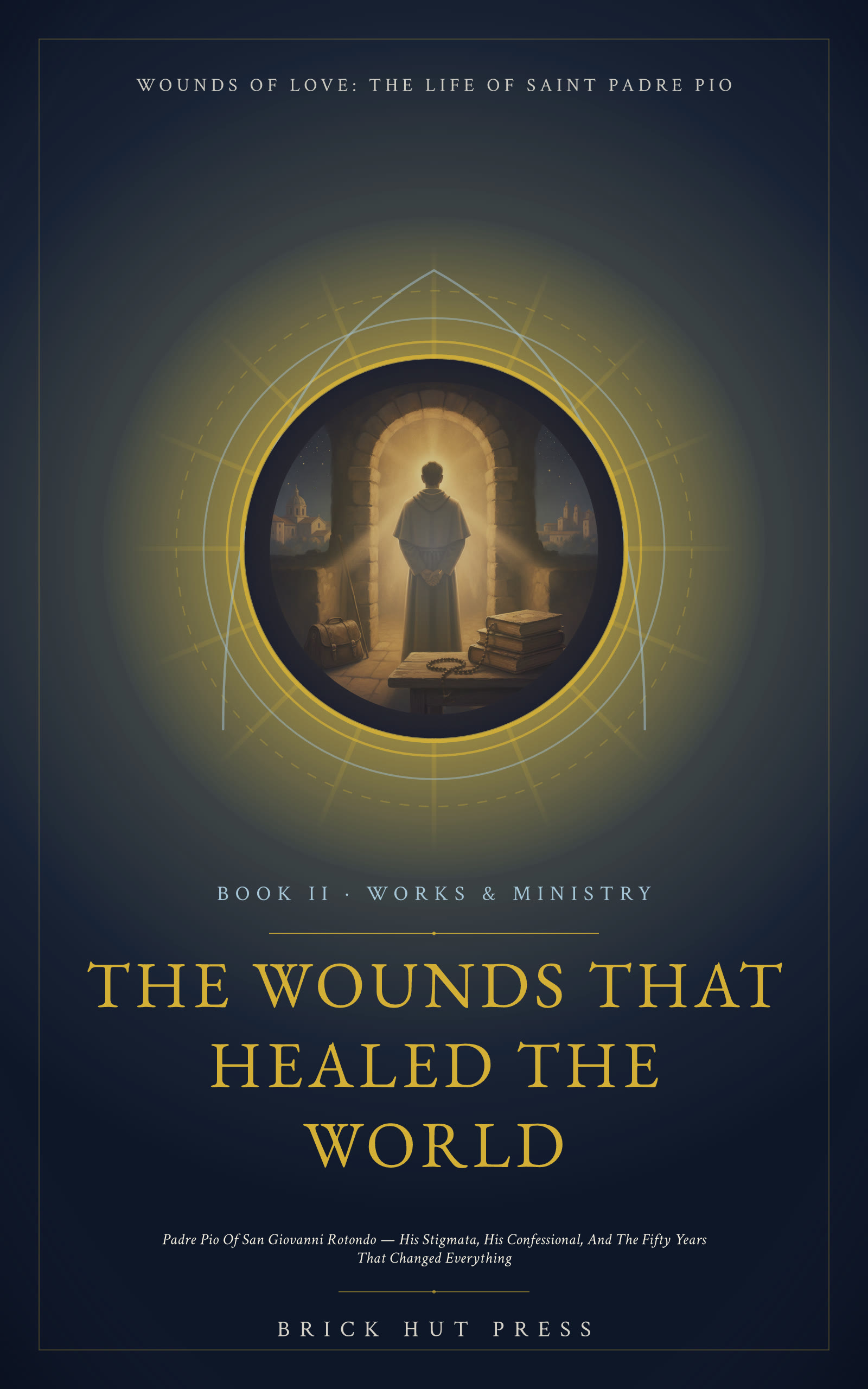
The Wounds That Healed the World
He Bore the Wounds of Christ for Fifty Years, and Spent Every One of Them on You Behind the familiar image, the brown habit, the fingerless gloves, the prayer card, stands a man of staggering depth. A friar who bled, battled dark spirits, heard confessions for hours without end, and built a hospital on nothing but faith. The Wounds That Healed the World moves past the medal and into the life: the full, luminous, sometimes agonizing story of Padre Pio of San Giovanni Rotondo.
Read the full description
This is the portrait for readers who want more than a devotional sketch. Warm, detail-rich, and honest, it holds the mystery of his mystical gifts alongside the very human weight of his long Calvary, his years under ecclesiastical scrutiny, and the pastoral heart that refused to let a single soul walk away unfound. If you have ever pressed his medal and whispered a prayer, this book answers the question you were really asking: Who is this man?
About this volume
This is the volume where the private and the public meet, where a young friar's hidden sufferings become visible to the world and never again fully belong to him alone. Volume 1 followed the boy from Pietrelcina into the habit of the Capuchins and traced the early, half-glimpsed wounds of a soul being formed for something it could not yet name. This second volume opens on the morning that changed the shape of the story: September 20, 1918, in the choir chapel of Our Lady of Grace, when the marks of the Crucified appeared on Padre Pio's hands, feet, and side, and stayed there for fifty years. The chapter that opens this volume does not rush past the six weeks of preparation before it, the transverberation of August 5, the piercing of the heart that left no mark but an ache that never left him, because the wounds of the body cannot be understood apart from the wound of love that preceded them.
From there the volume follows the long, strange arc of a man asked to live an entire life in public while his deepest experience remained radically hidden even from himself. "The Fragrance of a Living Mystery" and "Under the Church's Gaze" take up what came next: the pilgrims who began arriving at San Giovanni Rotondo, the reports of a sweetness in the air near him that no one could explain, and the scrutiny, sometimes suspicious, sometimes hostile, that the Church itself brought to bear on a friar bearing what looked like the wounds of Christ. This volume does not soften that scrutiny into a footnote. It treats seriously the investigations, the periods of restriction, the years when Padre Pio was forbidden to say Mass publicly or hear confessions, and it asks the reader to sit inside that obedience with him rather than past it.
At the center of the book stands the confessional, and rightly so. "Father of the Confessional," "The Letters That Cross the Ocean," and "He Knew What You Were Going to Say" form the spine of this volume because the confessional, more than the wounds themselves, is where Padre Pio's fifty years at San Giovanni Rotondo were actually spent, ten, twelve, sixteen hours a day, penitents queuing before dawn, men and women who traveled from across Italy and across oceans to kneel before a priest who seemed, again and again, to know the sin before it was spoken. This volume does not treat that knowledge as a curiosity. It treats it as mercy wearing a strange and exacting face, mercy that could be gentle with the truly contrite and severe with the evasive, because Padre Pio understood confession as a matter of eternal weight.
The volume also makes room for the phenomena that surrounded him without letting them crowd out the man: the bilocations recounted in "A Presence in Two Places," the reports of a friar seen and heard in two places at once, tending the dying or comforting the distant, always in service of someone's need rather than his own renown. "The Enemies He Never Stopped Loving" turns to something harder and, in its way, more important than any wonder, his patience with those inside and outside the Church who worked against him for years, and his refusal to answer suspicion with bitterness. "A House for Those Who Suffer" follows the building of the Casa Sollievo della Sofferenza, the hospital he willed into existence from nothing, insisting that relief of the body's suffering belonged beside relief of the soul's.
The final chapters, "The Spiritual Children of the World" and "Fifty Years of Calvary," draw the volume toward its close by widening the frame to the countless people who considered themselves his children in a spiritual sense long before his death, and by naming plainly what his life had cost him: five decades of visible wounds, borne without complaint, in a body that was otherwise unremarkable and increasingly frail. This is not a book that asks its reader to marvel from a distance. It asks for the patience to sit in the confessional line, in the choir chapel before dawn, in the long years of suspicion and vindication, and to understand why so many people who knew Padre Pio only briefly came away certain they had been in the presence of someone carrying, quite literally, the wounds of Christ.
Not sure yet? Begin freely.
Marked by Love, a complete portrait of this life, free, kept in your own library here. The door into all 3 volumes.
Receive the free book →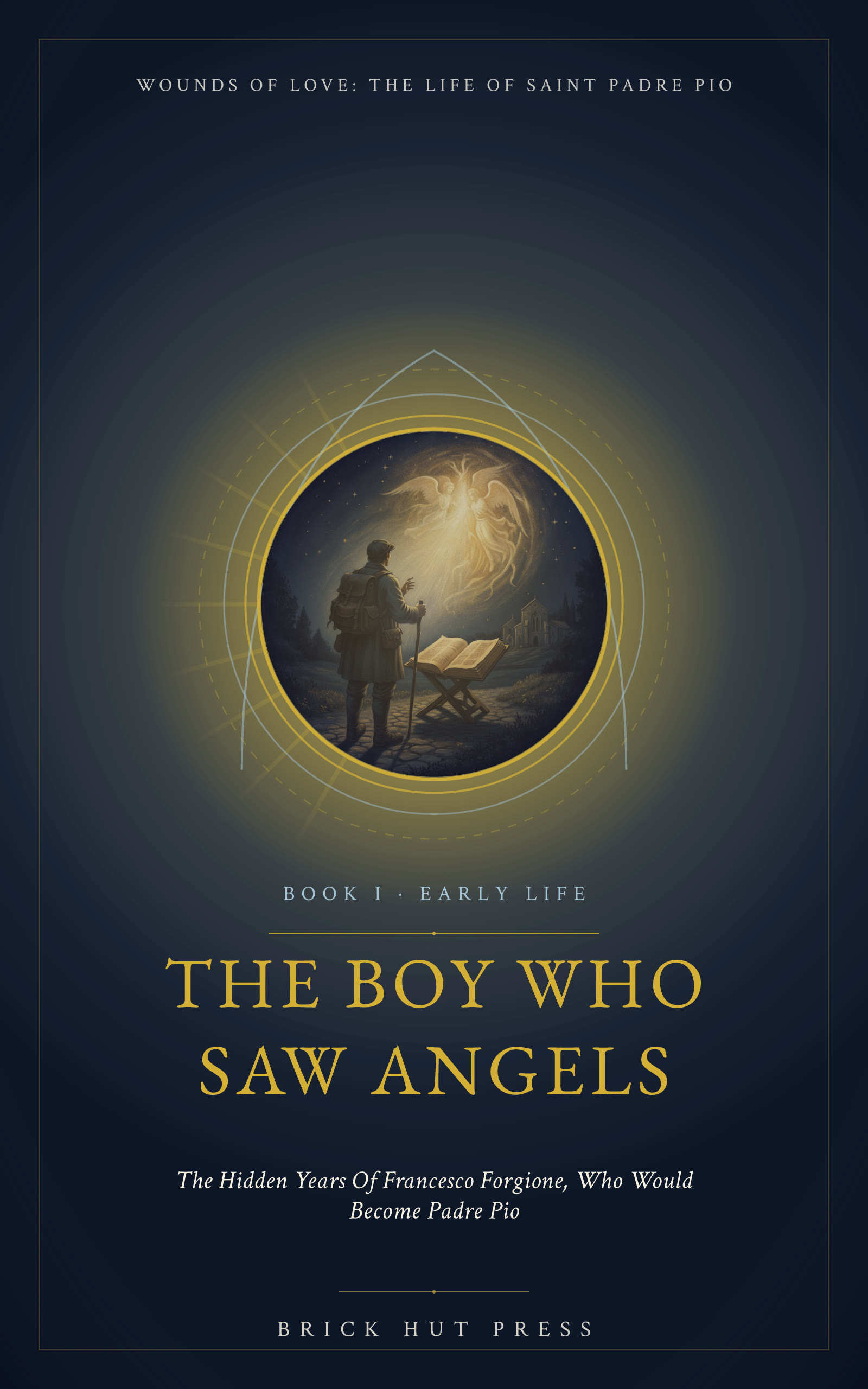
Lives that walk beside Saint Pio of Pietrelcina, chosen for their likeness, not their fame.