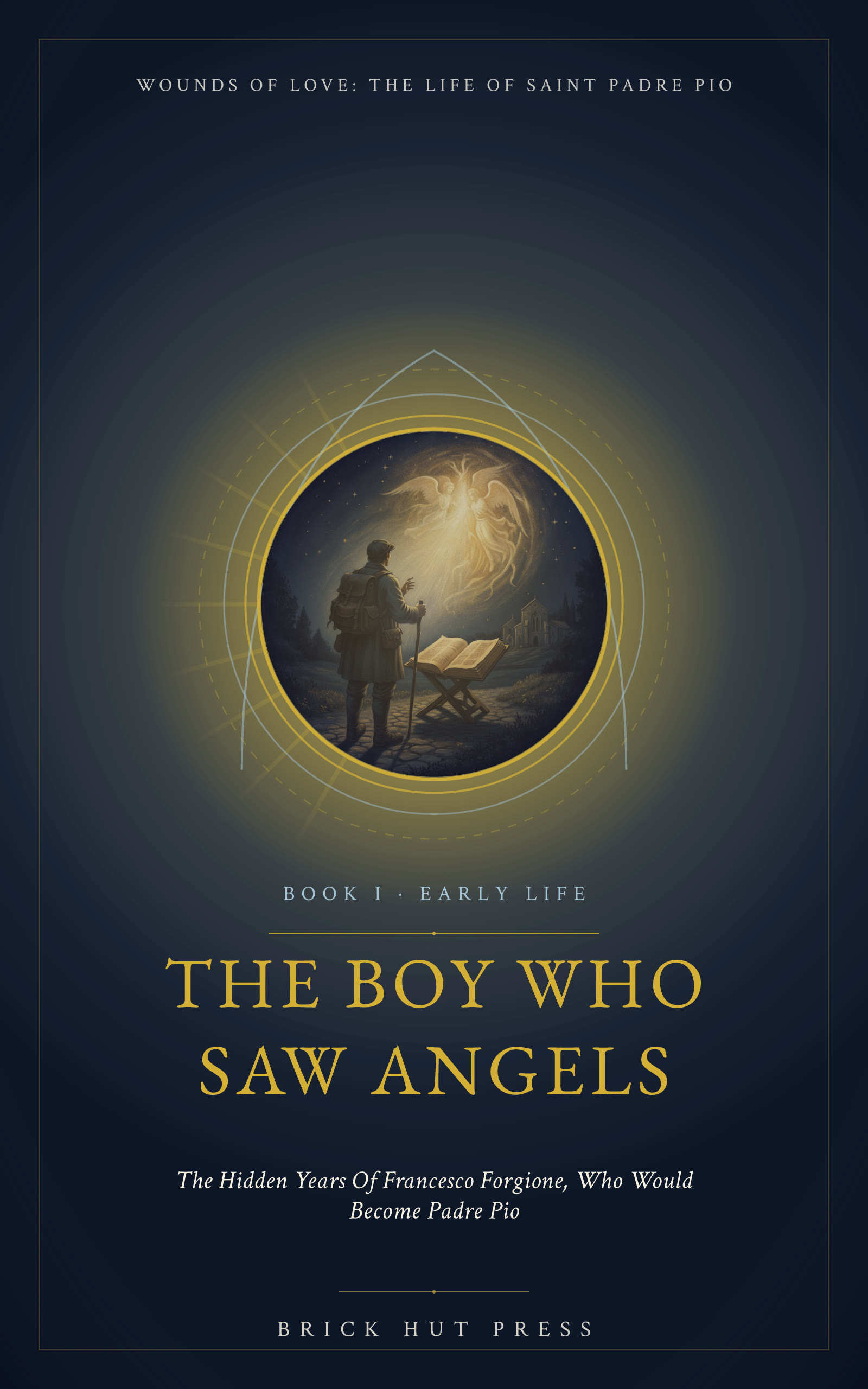
The Boy Who Saw Angels
Before the stigmata, before the confessional, there was a boy who saw angels. The world knows Padre Pio the stigmatist, the confessor, the intercessor whose wounds bore the marks of Christ's own Passion.
Read the full description
But long before the world knew any of that, there was a barefoot boy named Francesco Forgione , growing up in the hills of Pietrelcina, a child who already saw what others could not, who already suffered what others could not explain, and who already loved with a devotion that would one day set the whole Church on fire. The Boy Who Saw Angels opens the hidden years of one of the most beloved figures in modern Catholic devotion. Here is the whole man behind the prayer card, the child, the son, the young novice, the agonized seminarian, and here is the God who was shaping him every step of the way.
About this volume
Before Padre Pio was Padre Pio, before the stigmata, the confessional lines that stretched for days, the reports that reached Rome and unsettled it, there was a barefoot boy named Francesco Forgione, born into the dust and wheat of a Beneventan hill town, who is said to have seen what the rest of the household could not. This first volume of Wounds of Love stays with him there, in Pietrelcina, refusing to rush toward the wonders that would later make him famous. It asks a patient question: what kind of childhood, what kind of soil, produces a man who will one day bear the wounds of Christ in his own flesh? The answer, this book insists, begins not in a monastery but in a kitchen with olive wood smoke and an Angelus bell that measured out the hours of ordinary labor.
The chapters move with unhurried attention through the years that shaped him: the hills themselves, with their stony fields and their old, half-forgotten saints; the reports of a child who spoke easily of angelic visitors, as though the veil between worlds hung thinner over that particular house than over others; and the morning, treated here as a real hinge in a real life, not a legend, when young Francesco said yes to a vocation he could not yet have understood. From there the book follows him into the brown habit he had dreamed of as a boy, tracing the ordinary and extraordinary textures of formation: the discipline of religious life, the trials of a body that seemed, almost from the start, to resist him, and the slow, demanding work of becoming a man capable of holding both mortification and mercy in the same hands.
What distinguishes this volume is its refusal to treat Padre Pio's early years as mere prologue to the miracles. "Learning to Write His Heart" and "Solemn Vows, Solemn Gift" linger over the interior labor of a young friar wrestling honestly with his own soul, his letters, his doubts, his growing capacity for spiritual friendship and guidance, long before any of it had a public face. By the time the book reaches "Father Pio, Priest of God," the reader has watched an ordination not as a formality but as the culmination of years of hidden yes-saying, each one smaller and harder than the last.
The volume's final chapters carry the first true weight of what was to come. "The First Wounds, and Their Healing" approaches, with appropriate reticence, the earliest signs of the extraordinary suffering that would later mark him publicly, treated here with the same sober attention given to his childhood, neither sensationalized nor explained away. "A Soldier in a Friar's Habit" places him briefly against the disruption of a world at war, a young priest pulled, however incompletely, into history's larger currents even as his true battles remained interior. And "Come to This Mountain" closes the volume looking toward San Giovanni Rotondo, not yet the place of pilgrimage it would become, but a horizon, a summons, a mountain still waiting to be climbed.
Readers who come to this book already devoted to Padre Pio's later ministry, the confessional, the hospital he would build, the wounds that drew the world's attention, will find here something quieter and, in its way, more foundational: the years when none of that was yet visible, when he was simply Francesco, a boy from Pietrelcina learning to pray in a language the hills themselves seemed to teach him. This volume asks its readers to sit in that unglamorous beginning a while longer than is usual, trusting that the wounds of love have roots, and that those roots are worth knowing before the flowering.
Not sure yet? Begin freely.
Marked by Love, a complete portrait of this life, free, kept in your own library here. The door into all 3 volumes.
Receive the free book →
Lives that walk beside Saint Pio of Pietrelcina, chosen for their likeness, not their fame.