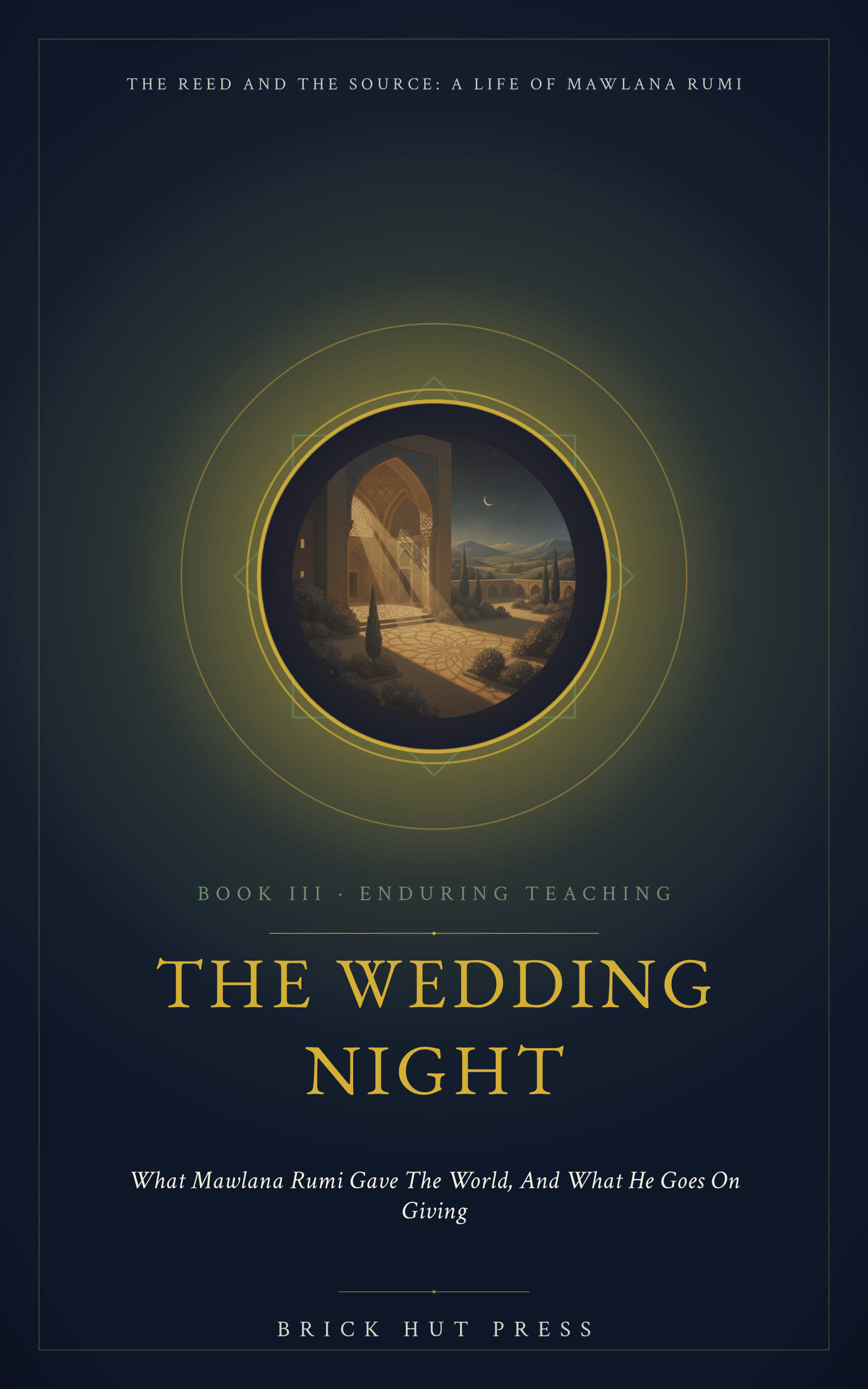
The Wedding Night
The Night That Never Ended, How Rumi's Soul-Fire Still Lights the Way Home Mawlana Jalal al-Din Rumi called his death his wedding night, the moment the soul returns, at last, to the Beloved it had never truly left. That luminous idea did not die with him in 13th-century Konya.
Read the full description
It crossed deserts and oceans, survived empires and centuries, and arrived, still burning, in the heart of every sincere seeker who has ever wept over a verse of the Masnavi or stood in stillness while the reed flute cried. The Wedding Night: What Mawlana Rumi Gave the World, and What He Goes on Giving is an act of devotion as much as a book. Written from within the living tradition, warm with reverence and luminous with insight, it traces the arc of Mawlana's gift, from the Sufi lodges of Anatolia to the restless, searching souls of the modern world, and places that gift gently in your hands.
About this volume
This is the volume where the story stops moving forward and begins moving outward, and, in a sense, never stops moving at all. The first two volumes of this series followed a single life through Balkh and Konya, through loss and love and the turning that made a jurist into a poet of the whirling breath. This third volume opens where that life ends: on a December evening in 1273, in a room where physicians have given up and the weeping has gone quiet out of respect. But Mawlana Rumi did not call this death, and neither does this book. He called it his wedding night, his shab-i arus, and the volume takes that word seriously, not as a poetic flourish but as a theological claim about what separation and reunion actually mean, and it asks what it cost the people who loved him to believe it.
The early chapters stay close to the grief itself, all of Konya weeping in the streets, Jews and Christians and Muslims said to have walked together behind the bier, and then to the quieter, harder work of what came after: a son, Sultan Walad, left to tend a flame he did not light, choosing continuity over ambition, shaping his father's circle of companions into something that could outlast a single teacher. From there the book turns to the Mevlevi Way itself, the order that grew from that tending, the sema, the turning, the discipline of walking a path in circles rather than toward a horizon, and asks what it means that a mystical order built its whole practice on the shape of return rather than arrival.
At the center of the volume sits the Masnavi, and here the book slows to do something patient and necessary: it traces how six books of Persian verse, dictated over years to Husam al-Din Chalabi, became what the tradition calls a world, dense with story, parable, and argument, meant to be lived with rather than finished. A full chapter, "The Theology of the Reed," takes up the image that gives this series its name, the reed cut from the reed bed and crying its longing in every note it plays, and asks how Mawlana's account of separation and yearning fits within the wider architecture of Islamic thought about the soul's origin and its homecoming. Another chapter insists, plainly and without apology, that this love was never freestanding, that Mawlana's devotion to the Prophets, and above all to the Prophet Muhammad, ﷺ, is the ground beneath every turn and every verse, not an ornament added afterward by pious readers.
The book then widens its lens across centuries and languages. It follows the tekke at Konya through Ottoman patronage and modern upheaval, a place that by every historical logic should have closed and did not. It traces the Persian original as it moved into Turkish devotion and Urdu poetry, becoming, in each language, something both faithful and new. And it follows the reed further still, into English translations and American bookstores, into wedding readings and greeting cards, asking honestly what has been gained and what has been thinned in that long crossing of oceans.
The final chapters turn practical and personal, offering guidance on how to actually sit with the Masnavi, not as a text to master but as a companion to return to, the way the Mevlevi turn returns to the same point without ever repeating the same turn twice. The volume closes, fittingly, not on an ending but on a recurrence: every December seventeenth, in Konya and far beyond it, when the wedding is remembered as still, somehow, underway. Readers who have followed Mawlana through the first two volumes will find here the completion they have been waiting for; readers meeting him for the first time will find a whole, sufficient portrait of why a thirteenth-century jurist's grief became a lamp so many traditions still gather around.
Not sure yet? Begin freely.
The Song the Reed Remembers, a complete portrait of this life, free, kept in your own library here. The door into all 3 volumes.
Receive the free book →