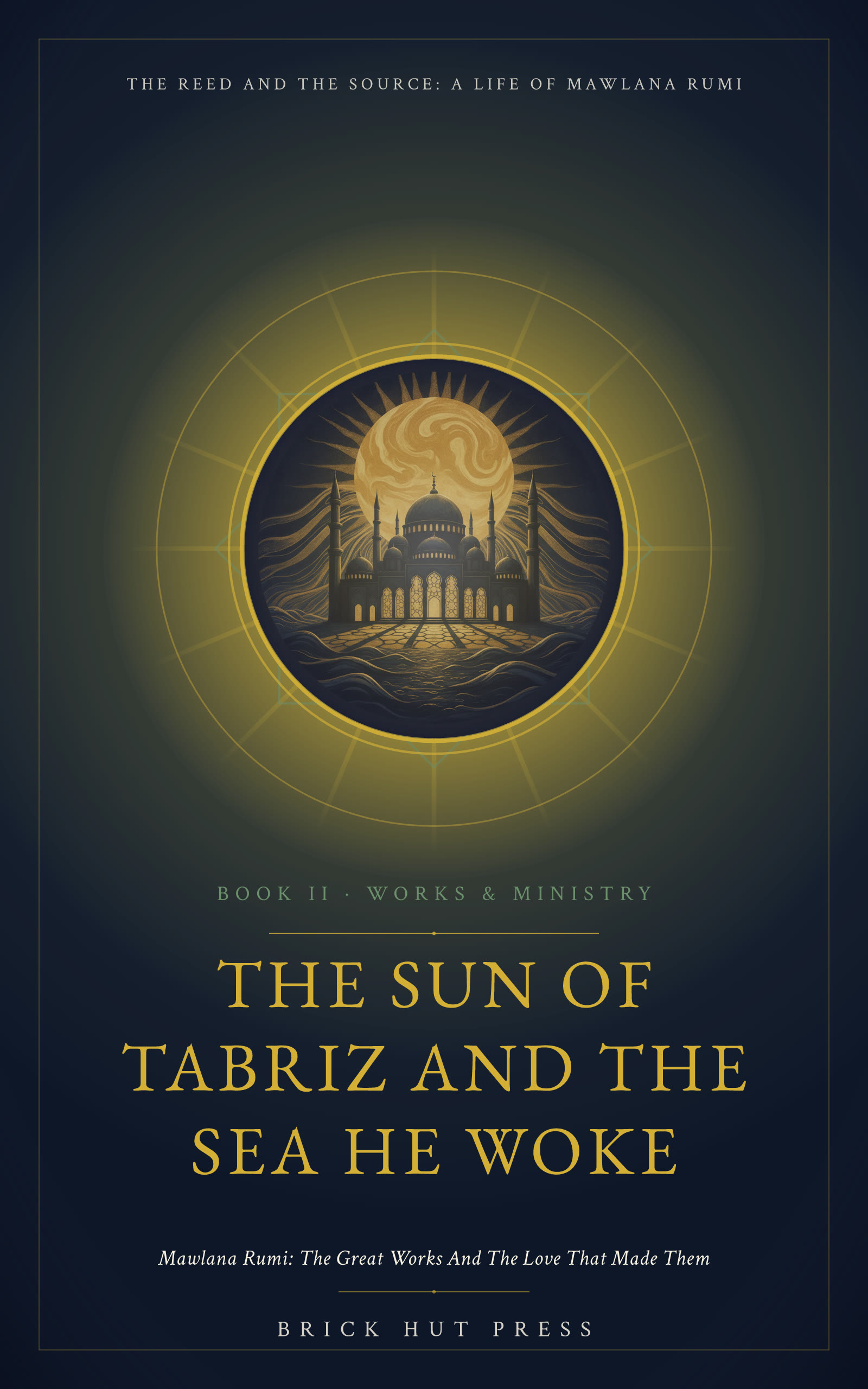
The Sun of Tabriz and the Sea He Woke
A Wandering Dervish. A Scholar on Fire. Six Books That Changed the Soul of the World. Before there was the Masnavi, there was a meeting. Before there was the Divan-i Shams, there was a burning. And before Mawlana Jalal ad-Din Rumi became the light that has guided seekers for eight centuries, there was a man, shattered open by love, rebuilt by grace, and set ablaze by the sun of Tabriz. This is that story.
Read the full description
Written from inside the tradition, with reverence, depth, and a friend's steady hand, The Sun of Tabriz and the Sea He Woke follows Mawlana Rumi through every love, every loss, every annihilation and return that made his great works possible. This is not a literary biography written from a safe distance. This is a sacred life, offered to those who already know that Mawlana is not merely a poet, and who hunger to understand how the poems came to be.
About this volume
This volume begins where the first left off, a settled scholar, a respected chair, a life that looked, by every outward measure, finished, and then breaks it open. The second book in The Reed and the Source takes up Mawlana Jalal ad-Din Rumi at thirty-seven, a jurist and teacher of unquestioned standing in Konya, and follows him through the encounter that undid and remade him: the arrival of Shams-i Tabrizi in the market that Thursday in November 1244, and everything that came after.
The chapters here do not rush past the difficulty of that friendship, nor soften it into simple hagiography. "What Shams Was" asks the question plainly, weighing the wandering dervish's fierce, uncompromising presence against the discomfort he caused a household and a community used to their shaykh's steadiness. "Three Years of Fire" traces the intensity of the bond itself, the seclusions, the disciples' bewilderment, the sense among Mawlana's own students that something essential was being taken from them even as something greater was being given. And the volume does not flinch from the losses: two disappearances of Shams are given their own chapters, each with its cost and its aftermath, culminating in a silence that Mawlana had to learn to live inside rather than resolve.
What this book insists on, though, is that grief did not end the story, it changed its instrument. Salah ud-Din the goldsmith and Husam al-Din al-Chalabi each receive their own chapter not as afterthoughts to Shams but as necessary companions in Mawlana's continuing transformation, men through whom love kept finding new shapes to heal in and new sparks to catch fire from. It is Husam al-Din's request, faithfully rendered here, that becomes the hinge of the whole volume: the moment that turns private ecstasy into the composition of the Masnavi, the "reed's endless song" that the book's central chapter opens outward to explore, not as literary artifact but as living instruction, dictated over years, verse answering verse, story folding into story.
Alongside the poetry, this volume keeps Mawlana in the world he never left: the shaykh at the minbar delivering the seven sermons that show him as preacher and pastoral guide as much as mystic; the teacher in the city interceding for petitioners, tending disciples, holding together a community that needed him present as much as it needed him transformed. The chapter on whirling as prayer treats the practice with the same seriousness the book gives everything else, not spectacle, but a bodily grammar for a love too large for words alone, arising from the same fire Shams first lit and Husam al-Din later gathered into verse.
The volume closes with "The Last Dictation," twelve years and six books compressed into what the tradition remembers as a single sustained breath, the Masnavi's completion and the quiet, hard-won maturity of a man who had been broken open by love and had spent the rest of his life turning that breaking into instruction for others. Readers of Book One will recognize the same patient attention to place and circumstance, the same refusal to invent what the sources do not give; readers new to Mawlana's story will find here the events his poetry keeps circling back to, named and dated and set in their proper streets and seasons. This is the volume where the reed is finally cut from the reed bed, and begins, painfully and gloriously, to sing.
Not sure yet? Begin freely.
The Song the Reed Remembers, a complete portrait of this life, free, kept in your own library here. The door into all 3 volumes.
Receive the free book →