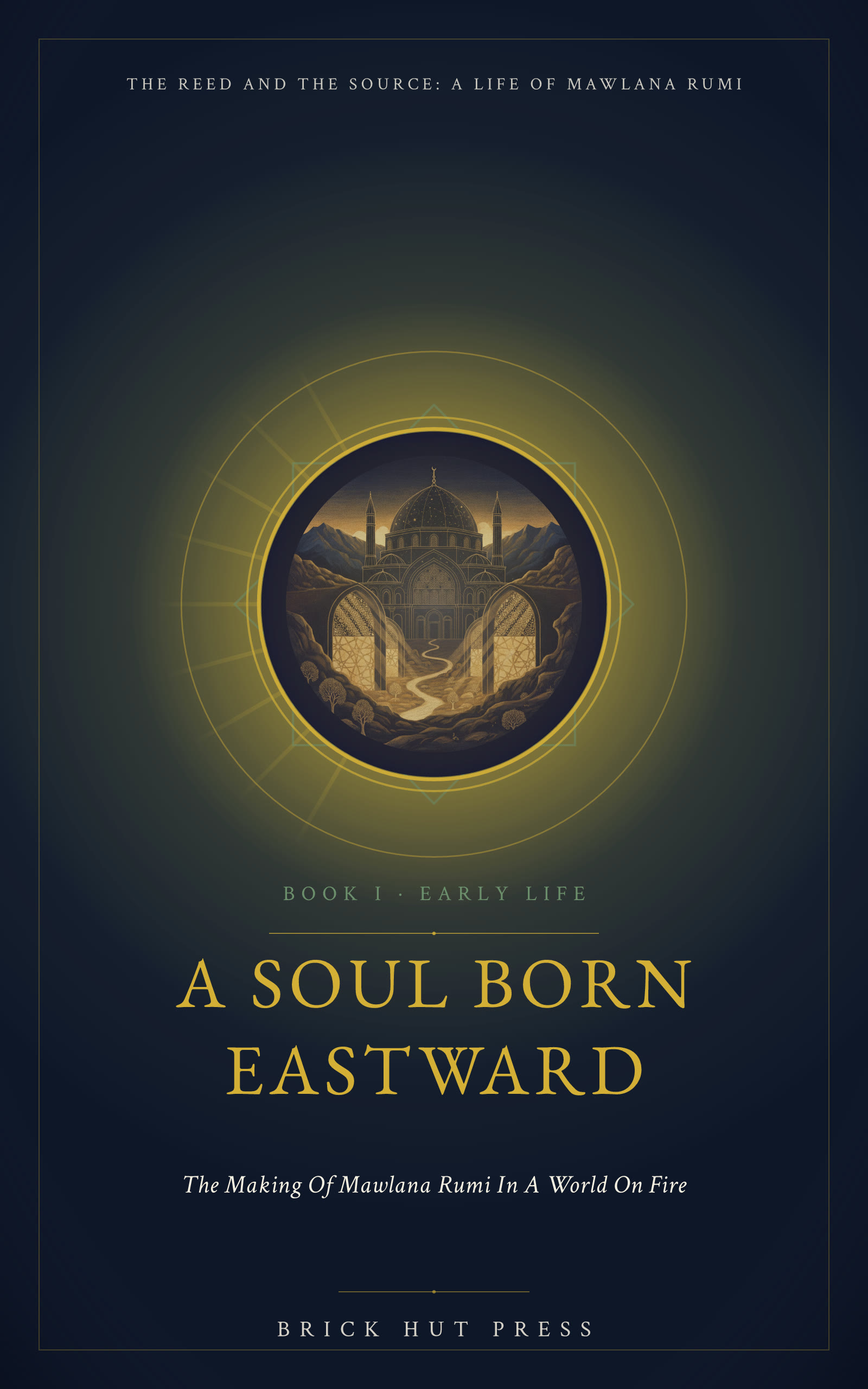
A Soul Born Eastward
About this volume
This first volume of The Reed and the Source begins where every great life must begin, not with the miracle of the Masnavi or the whirling that would one day bear his name, but with a household in Balkh, a father called the Sultan of the Scholars, and a boy named Muhammad who would only later, and gradually, become Mawlana. Readers who come to Rumi already loving the poetry of Divine longing sometimes skip past the plain historical ground beneath it; this volume asks them to stand on that ground a while. It wants the dust and rosewater of Balkh in the reader's nostrils before it lets the reader hear a single verse.
The arc here is the arc of formation, not fulfillment. We meet Baha ud-Din Walad, whose scholarship and spiritual seriousness shaped the household air the young Jalal ad-Din breathed daily, and we meet the world that was, even then, catching fire, the Mongol advance moving westward like weather, forcing a family that had known centuries of settled learning into the uncertain posture of exile. The chapters on the road through Baghdad and Mecca are not a travelogue for its own sake; they are the record of a boy becoming a young man inside displacement, carrying a city he would never stop carrying even as the caravan put mile after mile between him and Balkh's minarets. Readers who want to understand why loss and longing sit so close together in Rumi's later verse will find here the lived cause before the literary effect.
There is a chapter given to Farid ud-Din Attar, the aged poet who is said to have seen in the traveling child something the child himself could not yet see, a moment the volume treats with appropriate restraint, neither inflating it into prophecy nor dismissing it as legend, but letting it stand as the tradition itself has always let it stand: a recognition, offered and received, its full meaning deferred. This is characteristic of how the book handles the whole first half of Mawlana's life, patient with mystery, unwilling to rush toward the famous encounters that lie ahead in later volumes, insistent that the man who would one day speak of the reed cut from the reed bed was, for a long time, simply a reed still growing in it.
Konya occupies the volume's middle turn, not as a destination reached but as a wandering stopped, the family's long displacement finally settling into a city that would become, in every sense that matters, his city, the way Balkh once was. Here the volume slows to consider the ordinary furniture of a holy life: marriage to Gevher Khatun, the grounding love of household and children, the daily texture of a jurist's household in a Seljuk capital not yet aware of what it was sheltering. And here too comes grief, a father's death, treated in this book not as a plot device clearing the stage for what follows, but as the genuine rupture it was, the kind of loss that does, in fact, open things in a soul that would otherwise have stayed closed.
The volume's final chapters turn to the man who would take that grief and that inheritance and forge them: Burhan ud-Din Muhaqqiq, teacher for nine long years, and the delicate, serious portrait of Rumi himself as a working jurist, a man who held infinity lightly even while discharging the ordinary duties of law and preaching. The book closes, deliberately, at the reed bed before the cutting: before Shams, before the turning, before the poetry that would carry his name across eight centuries. It is an unfinished portrait by design, offered to readers willing to meet Mawlana first as a son, a student, an exile, and a scholar, before meeting him as the voice the whole Sufi world still calls, simply, Our Master.
Not sure yet? Begin freely.
The Song the Reed Remembers, a complete portrait of this life, free, kept in your own library here. The door into all 3 volumes.
Receive the free book →