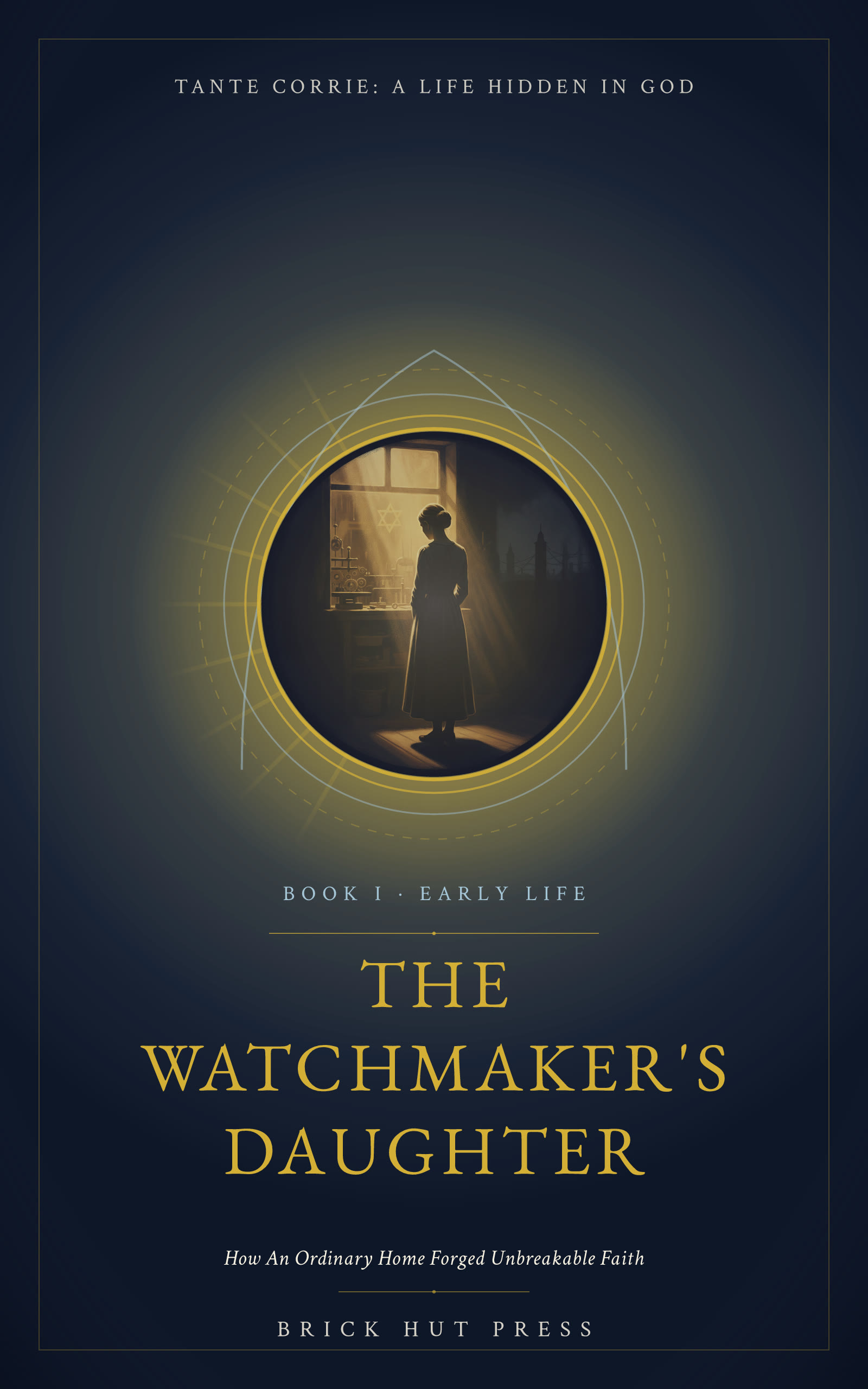
The Watchmaker's Daughter
Before the Hiding Place, There Was a Home That Changed Everything You already know what Corrie ten Boom survived. But do you know what made her unbreakable? It wasn't the concentration camps. It wasn't the secret room behind a false wall. It was a watchmaker's table in Haarlem, set with simple food, open to strangers, and saturated with a faith so ordinary it was easy to overlook and so deep it was impossible to destroy.
Read the full description
The Watchmaker's Daughter takes you back before the hiding place, before the barbed wire, before the forgiveness that stunned the world, to the unhurried hours where Corrie ten Boom was quietly formed. This is the story of how God does His most enduring work not in dramatic rescue but in the faithful, unflashy rhythms of an everyday home. A Life That Still Speaks, and a God Who Still Works If you've loved Corrie ten Boom's own telling of her story, you know how rare it is to encounter a life that makes the sovereignty of God feel real rather than theoretical. This book opens that story wider, reaching into the years and habits that shaped her courage long before she needed it. And if you're meeting Corrie for the first time, prepare to be permanently changed.
About this volume
Before there was a hiding place, there was the Beje, a narrow house on Barteljorisstraat where clocks disagreed cheerfully about the hour and a father's hands moved with the same patient exactness whether he was setting a mainspring or answering a child's question about God. This first volume of Tante Corrie: A Life Hidden in God does not begin with the war that made her name known around the world. It begins where her character was actually made: in a watch shop above which a family had lived and prayed and welcomed strangers for three generations before the Nazis ever crossed into Holland.
Readers who know Corrie ten Boom only from the barracks of Ravensbrück will find here the quieter, longer story that made that later courage possible. The Watchmaker's Daughter follows young Cornelia from infancy through the shaping years of her girlhood, a child who, the book insists, "knew she was loved" before she could read a word of Scripture, and who at five years old was already learning to say yes to God in matters no five-year-old is usually asked to decide. Chapters on the family table that "always had room," on Casper ten Boom's hands and the God those hands pointed to, and on the household's daily rhythm of prayer, work, and welcome, build a portrait of ordinary Dutch domestic piety, the kind that rarely makes headlines but quietly forms saints.
The volume is unafraid of the harder textures of that formation. "The Girl Who Asked the Hard Questions" takes seriously that Corrie's faith was not handed to her as an easy inheritance but wrestled toward, through doubt and childish protest, in a home that made room for both. "The Love She Was Not Given" turns toward a wound rather than around it, honoring the fact that even a home as full of God as the Beje could not spare a child every sorrow, and that faith, for the ten Booms, was never a shield against grief so much as a companion inside it. This is a book willing to let its subject be young, uncertain, and sometimes disappointed, because that honesty is what makes her later steadiness believable rather than merely legendary.
The later chapters begin to turn Corrie outward. "The Woman with the Loupe" follows her into her father's trade, the first Dutch woman licensed as a watchmaker, learning precision and patience at the same bench where she had once watched him work. "Tante Corrie and the Girls of Haarlem" shows the beginnings of the ministry that would define her adult life, as she gathers young women, troubled, poor, disabled, unwanted by others, into clubs and classes that mirror the welcome she herself received at that crowded family table. And "The Night Willem Could Not Sleep," closing the volume, lets the shadow of the coming war fall across the household for the first time, as her brother senses, before most Dutch citizens will admit it to themselves, what is gathering at the borders of Europe.
What this volume offers, finally, is not suspense about what Corrie ten Boom will become, every reader already knows the outline of Ravensbrück and the hiding place behind the false wall, but insight into how such a woman could become possible at all. It asks the same question its opening pages ask outright: what kind of home produces someone capable of forgiveness in a death camp? Its answer is patient and unsentimental, not a single dramatic conversion, but decades of clocks chiming true, of a father's steady hands, of a table with room for one more, and of a girl learning early, in small unspectacular acts of obedience, to say yes to the God who would later ask so much more of her. For readers who want to understand Corrie ten Boom before she was tested, this is the necessary first book, the quiet years without which the famous ones make no sense.
Not sure yet? Begin freely.
Deeper Still, a complete portrait of this life, free, kept in your own library here. The door into all 3 volumes.
Receive the free book →
Lives that walk beside Cornelia, chosen for their likeness, not their fame.