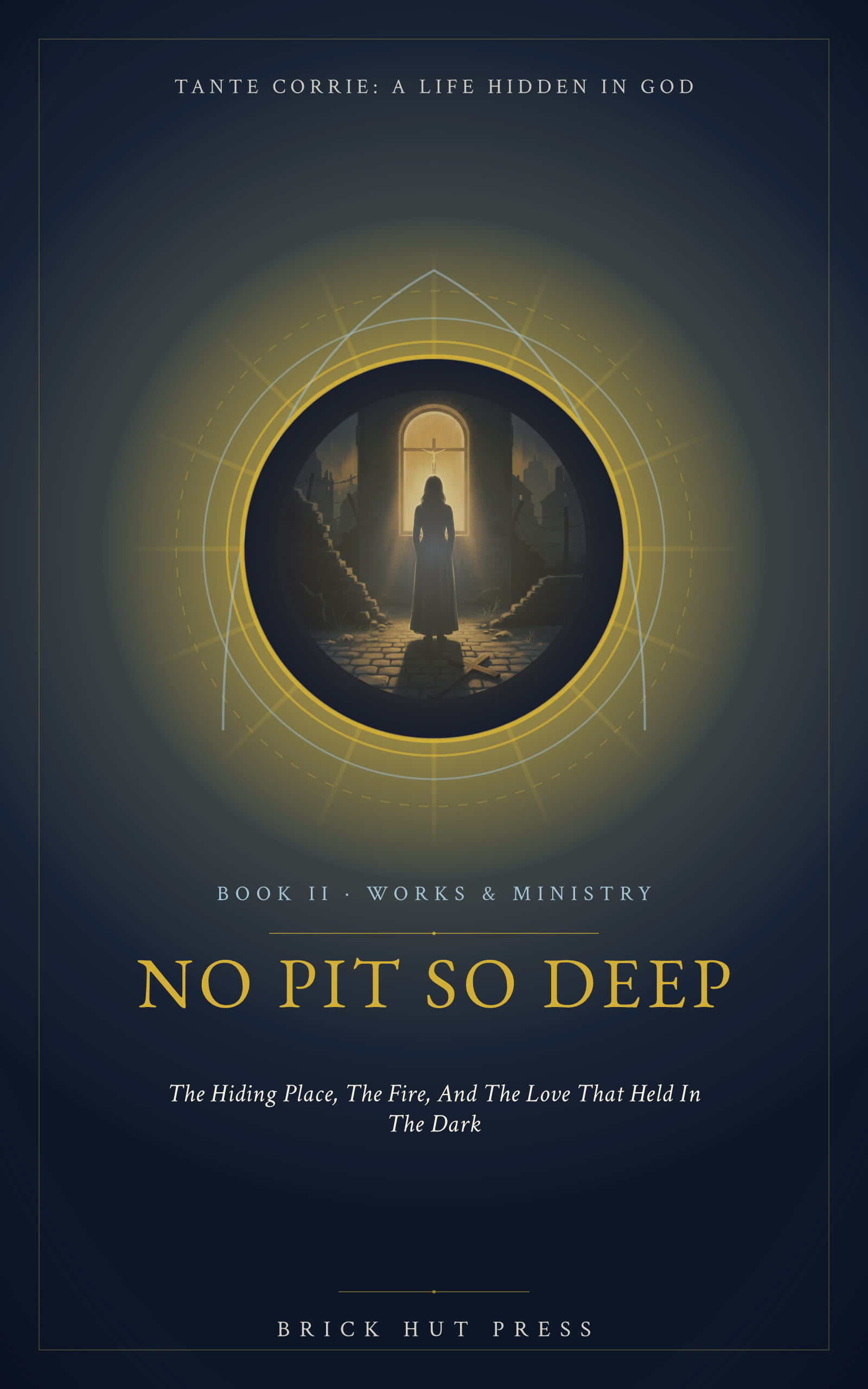
No Pit So Deep
When Everything Is Stripped Away, What Remains? In a small watch shop in Haarlem, a family made a choice that would cost them everything, and reveal a love that could not be extinguished even in the darkest place the Third Reich built for women.
Read the full description
No Pit So Deep is the story of Corrie ten Boom, a watchmaker's daughter who hid Jewish refugees beneath her home, was betrayed, and was dragged into the machinery of Nazi terror, all the way to the infamous barracks of Ravensbrück concentration camp. This is not a comfortable story. But it is a true one. And in every loss, every crushing grief, every moment when heaven seemed silent, something deeper kept breaking through. If you have ever loved Corrie ten Boom's testimony, or if you are encountering her for the very first time, No Pit So Deep traces her journey with clear eyes and deep conviction, refusing to soften the darkness and refusing to abandon the God who proved more powerful than it. This is the book for readers who believe in a sovereign God and hunger to see what His faithfulness actually looks like when it costs everything.
About this volume
Before this second volume opens, the reader should know that it takes up Tante Corrie's life at its hinge, the moment the ordinary Haarlem of the Beje, with its watch-shop bell and its crooked floorboards, gave way to the years that would make her name a byword for costly mercy. Volume One gave us the girl who learned to walk and pray in that house; this volume gives us the woman the war required her to become, and it does not look away from what that becoming cost. From the trembling windowpanes of May 1940 to the wooden bunks of a German concentration camp, the book follows a family's slow, deliberate turn from ordinary Dutch respectability into open defiance of the Reich, and asks, at every step, what it means to obey God rather than men when the penalty is not embarrassment but death.
The chapters move with the patience of memory rather than the haste of plot. "When Obedience Walked Through the Door" and "The Room Behind the Wall" trace the practical, almost domestic mechanics of how the ten Booms became hiders of the hunted, the false wall built by a family friend, the ration cards begged and forged, the rhythm of a household that had to seem unchanged while sheltering strangers a few feet from where the Gestapo might stand. "What Betsie Knew" turns from logistics to soul, giving proper weight to Corrie's older sister, whose frailty of body concealed a clarity of spirit that would guide them both through everything to come. The volume does not rush past the arrest. "The Last Morning," "Ten Days," and "Letters from Scheveningen" sit inside the disorientation of prison, the silence, the waiting, the strange mercy of a smuggled note, before "Together Again at Vught" reunites the sisters and carries them, inexorably, toward Ravensbrück.
It is in the camp chapters that this volume does its most difficult and most necessary work. "Ravensbrück: The Miracle in the Bottle" and "The Fleas and the Thanksgiving" hold together two things readers may not expect to find in the same room: the arithmetic of starvation and cruelty, and a stubborn, almost scandalous gratitude that Betsie insisted on even for vermin, because vermin kept the guards away. This is not triumphalism painted over suffering. It is an honest account of two women choosing, hour by hour, to believe that no barrack, no roll call, no pit of degradation was so deep that God's love could not reach the bottom of it, the conviction that gives the volume its title and its argument.
"Betsie's Last Words" and "A Clerical Error and a Sovereign God" bring the volume to its most searching turn, where sisterly love and sovereign providence meet without either canceling the other. Betsie's dying vision of a house of healing is not treated as decoration; it is set down as a promise Corrie would spend the rest of her life trying to keep, and the book is careful to let that promise breathe rather than resolve it too quickly. The closing chapter, "The House Betsie Saw," looks forward without pretending to answer everything a reader might want answered, it simply shows a woman released by what her book calls, with quiet understatement, an error in paperwork, carrying her sister's last words like a lamp into whatever came next.
This is a volume for readers who want the hiding place and the fire together, without one softening the other, who want to sit with the fleas and the thanksgiving in the same sentence and understand why Betsie insisted on both. It asks nothing of the reader but attention, and it repays that attention with a portrait of faith tested past the point most of us will ever be asked to go, and found, even there, to hold.
Not sure yet? Begin freely.
Deeper Still, a complete portrait of this life, free, kept in your own library here. The door into all 3 volumes.
Receive the free book →
Lives that walk beside Cornelia, chosen for their likeness, not their fame.