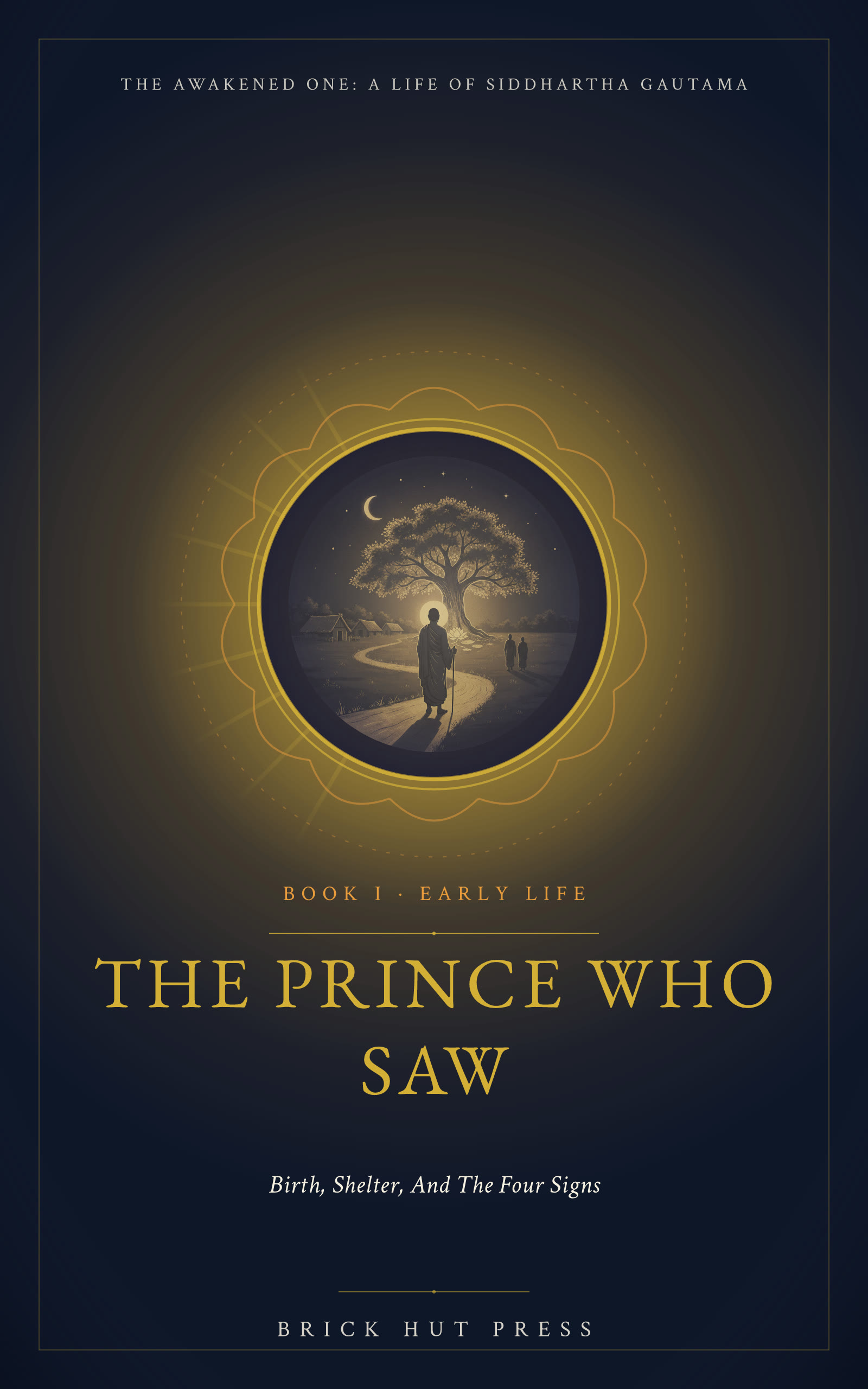
The Prince Who Saw
He Had Everything a Kingdom Could Give, and It Was Not Enough A radiant dream. A royal birth beneath flowering trees. A childhood wrapped in silk, music, and every pleasure a devoted father could conjure. And yet, beneath all of it, something stirred, a knowing that no palace wall could contain, no festival could silence, no arranged perfection could satisfy.
Read the full description
The Prince Who Saw: Birth, Shelter, and the Four Signs invites you to walk beside Siddhartha Gautama from his very first breath, to witness the luminous signs surrounding his arrival, to linger in the sheltered gardens where a prince was kept from the rawness of the world, and to stand with him at the gate when that world finally broke through. This is not a retelling at arm's length. It is a pilgrimage into each moment, told with warmth, care, and the quiet reverence that sacred story deserves. Part of the BrickHut Sanctuary, Sacred Lives series, this volume is offered in the spirit of production unconditional after sufficiency, created not to sell a brand but to serve the path. For Buddhist practitioners and sincere sympathizers of every school, it is an opportunity to meet the Buddha not as a distant icon but as a living presence: a young man whose questions are also your questions, whose longing mirrors the longing that first brought you to practice.
About this volume
This first volume of The Awakened One opens not with a doctrine but with a household, the palace at Kapilavastu, the fasting queen, the particular hush of a full-moon night, and it stays close to that household for the length of a life not yet broken open. Readers meeting Siddhartha Gautama for the first time, or returning to him after years of hearing him spoken of only as the Buddha, will find here the slower, earlier story: the dream of the six-tusked elephant, the birth beneath the sal trees at Lumbini, the old sage Asita who looks at the infant prince and weeps for reasons he will not fully explain. These are not treated as curiosities to be explained away or credulously multiplied, but as the tradition itself has long held them, the visible surface of something the child himself does not yet understand.
The middle chapters take up the long, deliberate architecture of shelter. King Suddhodana's palace of three seasons, built to keep old age, sickness, and death forever out of his son's sight, is rendered here not as a father's folly but as a father's love pressed to its limit, a love that will, in the end, prove unable to hold back what the world simply is. Alongside this we see the prince as a young man of the court: the bow he draws that no other can draw, the questions he keeps asking that no tutor can quite answer, and the marriage to Yasodhara, given its own chapter and its own dignity, so that this is not a life that begins with renunciation but a life that first has something real to renounce.
The heart of the volume is the encounter every tradition of the Buddha's life returns to, the four signs, given here room to breathe rather than compressed into a single scene. The old man by the road. The sick man. The corpse carried through the streets. And then the fourth sight, the wandering ascetic whose bearing tells the prince, before any word is spoken, that a different way of standing in the world is possible. The volume does not rush past the weight of what Siddhartha sees, nor does it explain it away with foreknowledge; it lets the shock land on him the way it must have landed, as the collapse of an illusion he had been raised inside without knowing it was an illusion.
What follows is the hardest turn any life of the Buddha must make, and this volume does not soften it: the birth of Rahula, named for the fetter his father feels closing around him even as he holds him, and then the departure itself, undertaken at night, by one candle's light, while the household sleeps. The chapter on the Great Departure keeps its attention where the earliest accounts keep theirs, on the leaving, not as triumph but as a decision made in near-total dark, uncertain and costly. And the volume's final word is given not to the prince but to the wife he leaves behind: Yasodhara, waking to an empty room, closes this book the way the tradition insists she must be remembered, not as a footnote to his going but as the one left to carry, alone, the ordinary morning after an extraordinary night.
This is a volume for readers who want the Buddha's life told from its true beginning, in the order and at the pace the old sources give it, patient with the dream before the birth, patient with the palace before the departure, patient with the wife before the road. It asks no prior familiarity with Buddhist teaching, only a willingness to sit, as Queen Maya did, inside a night that seems ordinary until it is not.
Not sure yet? Begin freely.
The Morning Star, a complete portrait of this life, free, kept in your own library here. The door into all 3 volumes.
Receive the free book →
Lives that walk beside Siddhartha Gautama, chosen for their likeness, not their fame.