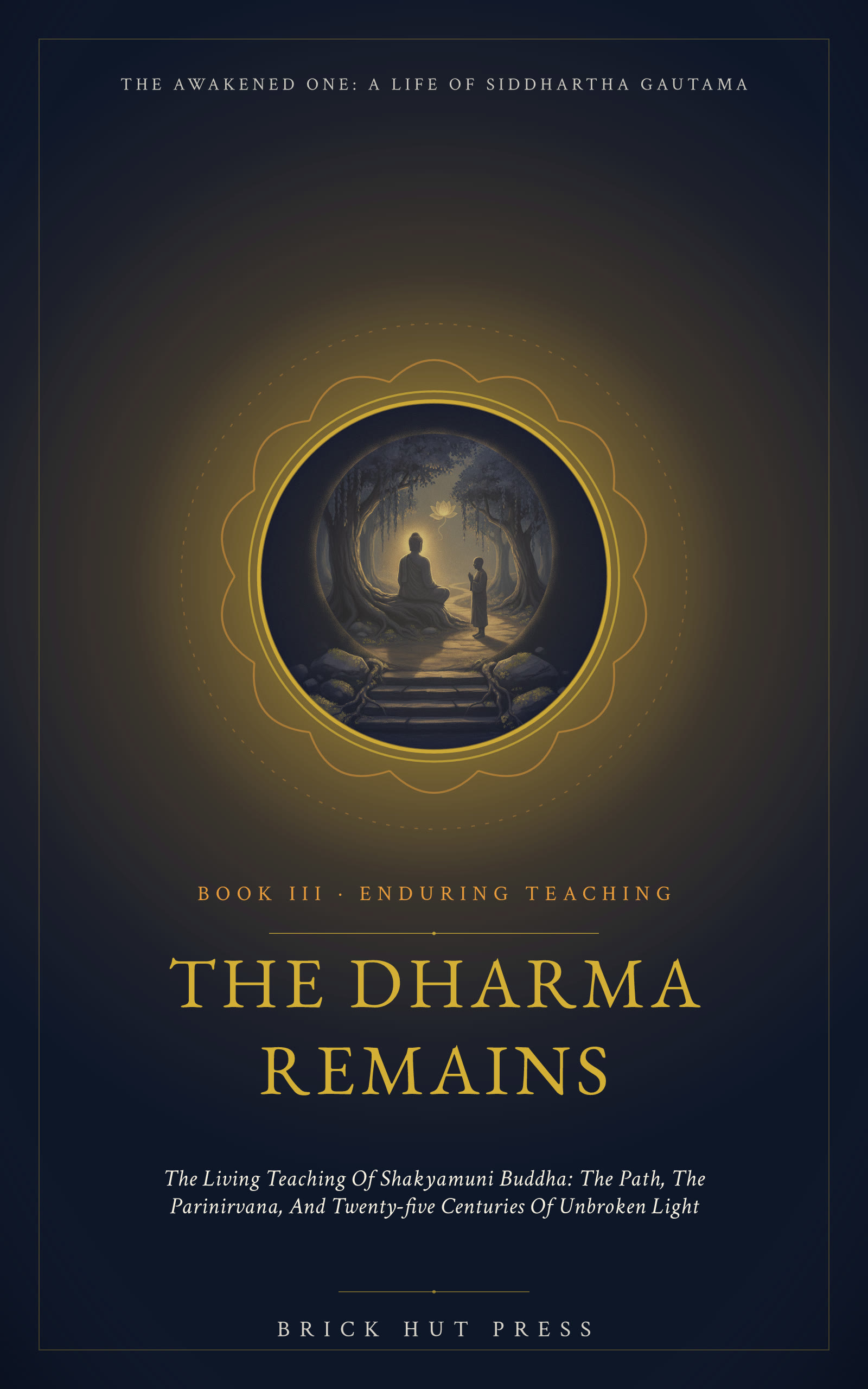
The Dharma Remains
The Buddha Never Left. The Dharma Is Still Speaking, And It Is Speaking to You. On the night of the full moon at Kushinagar, as the sal trees bloomed out of season and the earth itself bore witness, Shakyamuni Buddha offered his final and most profound gift. Not a relic. Not a successor. Not a doctrine carved in stone. He offered the Dharma itself, alive, luminous, and inexhaustible, as the living master that would never die.
Read the full description
The Dharma Remains is the story of that gift traveling across twenty-five centuries to arrive, right now, in your hands. From the First Council at Rajagriha to the great monasteries of Nalanda and Vikramashila, from the Silk Road caravans carrying sutras into China to the forest traditions of Southeast Asia, from the tantric lineages of Tibet to the meditation halls of the modern West, the unbroken light has never been extinguished. This book walks that entire journey with you, not as a scholar's survey, but as a dharma friend pointing again and again to what has always been present. Written with the warmth of long practice and the clarity of deep study, The Dharma Remains is for every Buddhist practitioner, Theravāda, Mahāyāna, or Vajrayāna, and for every sincere seeker who wants to meet Shakyamuni Buddha not as a figure of ancient history, but as a living presence on the path today.
About this volume
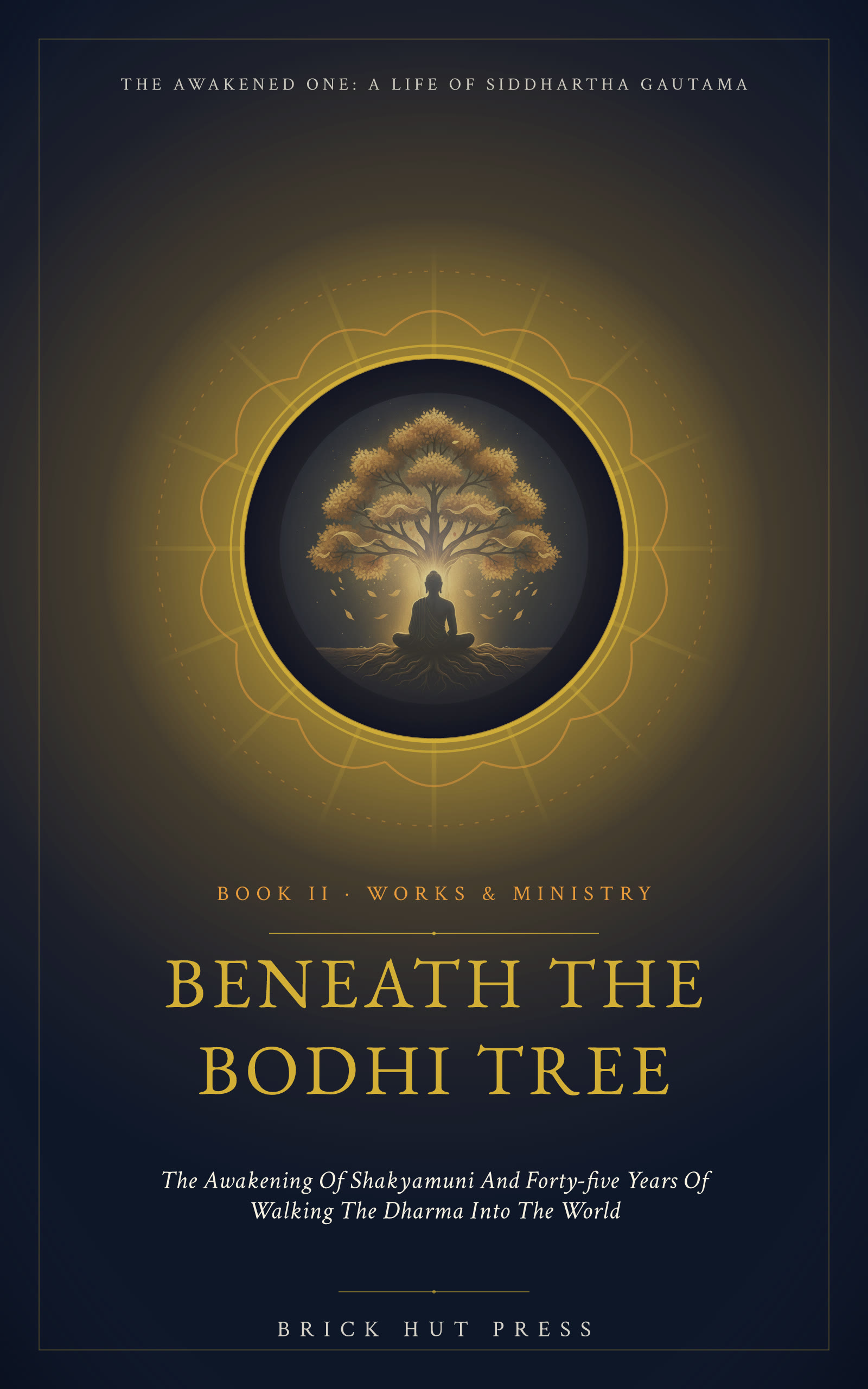
Every life of the Buddha must eventually leave the story of the man and enter the story of the teaching, and this is the volume where that turn happens. Where the first two books followed Siddhartha Gautama from Lumbini through the six years of striving to the awakening beneath the pipal tree at Bodh Gaya, this third volume opens with an ending, the sala grove at Kushinagar, the flowers falling out of season, the couch spread between two trees for a body about to lay itself down for the last time. But the book does not linger long on grief. It follows the tradition's own instinct, which was never to mourn the Teacher so much as to ask what would carry his presence forward once the breathing stopped. That question becomes the spine of everything that follows.
The opening chapters stay close to the record as the early tradition kept it: the last words spoken between the twin sala trees, and then the gathering at Rajagriha where five hundred arhats, led by Mahakasyapa, recited what they had heard and held it against one another's memory until a single accord emerged. This is presented not as antiquarian detail but as the hinge on which everything else turns, the moment a single life became, deliberately and communally, a teaching that could outlive any one person's testimony. From there the volume turns to the Dharma itself, laid out with the patience of someone walking a friend through it for the first time: the Four Noble Truths as diagnosis rather than doctrine, the Eightfold Path described plainly as a road wide enough for eight lanes of ordinary effort, dependent origination as a web with no center and therefore no first cause to hide behind, and the paired teachings of impermanence and not-self treated honestly as things that take courage to look at rather than comforts to recite. Nirvana receives its own careful chapter, addressed directly to the oldest misunderstanding, that it is extinction, and reframed as the ceasing of a fire, not the ceasing of a person.
The second half of the book widens the lens from teaching to transmission. There is a chapter on Ashoka, whose pillars carried the Dharma outward from the Gangetic plain to the edges of the known world, and a chapter that traces how one source divided, without rupture, into three rivers, Theravada, Mahayana, and Vajrayana, each carrying the same water by a different course. The bodhisattva vow gets its due as the great Mahayana elaboration of compassion, the vow to return for everyone rather than pass alone into release. Vesak, the full moon that gathers birth, awakening, and passing into a single night of remembrance, is treated as the living proof that the tradition still keeps its own calendar of gratitude. The book closes, appropriately, not with history but with practice, an invitation to take the Dharma into one's own hands rather than leave it in Kushinagar.
What distinguishes this volume within the series is its confidence that doctrine can be told as narrative, that the Four Noble Truths and dependent origination are not appendices to the Buddha's story but its actual continuation, the form his life took once it stopped being a life. Readers who came to the earlier volumes for the man will find here the reason his awakening mattered enough to survive him: a teaching precise enough to be recited by five hundred voices as one, supple enough to become three traditions, and still, twenty-five centuries later, walkable by anyone willing to take the first step onto the road.
Not sure yet? Begin freely.
The Morning Star, a complete portrait of this life, free, kept in your own library here. The door into all 3 volumes.
Receive the free book →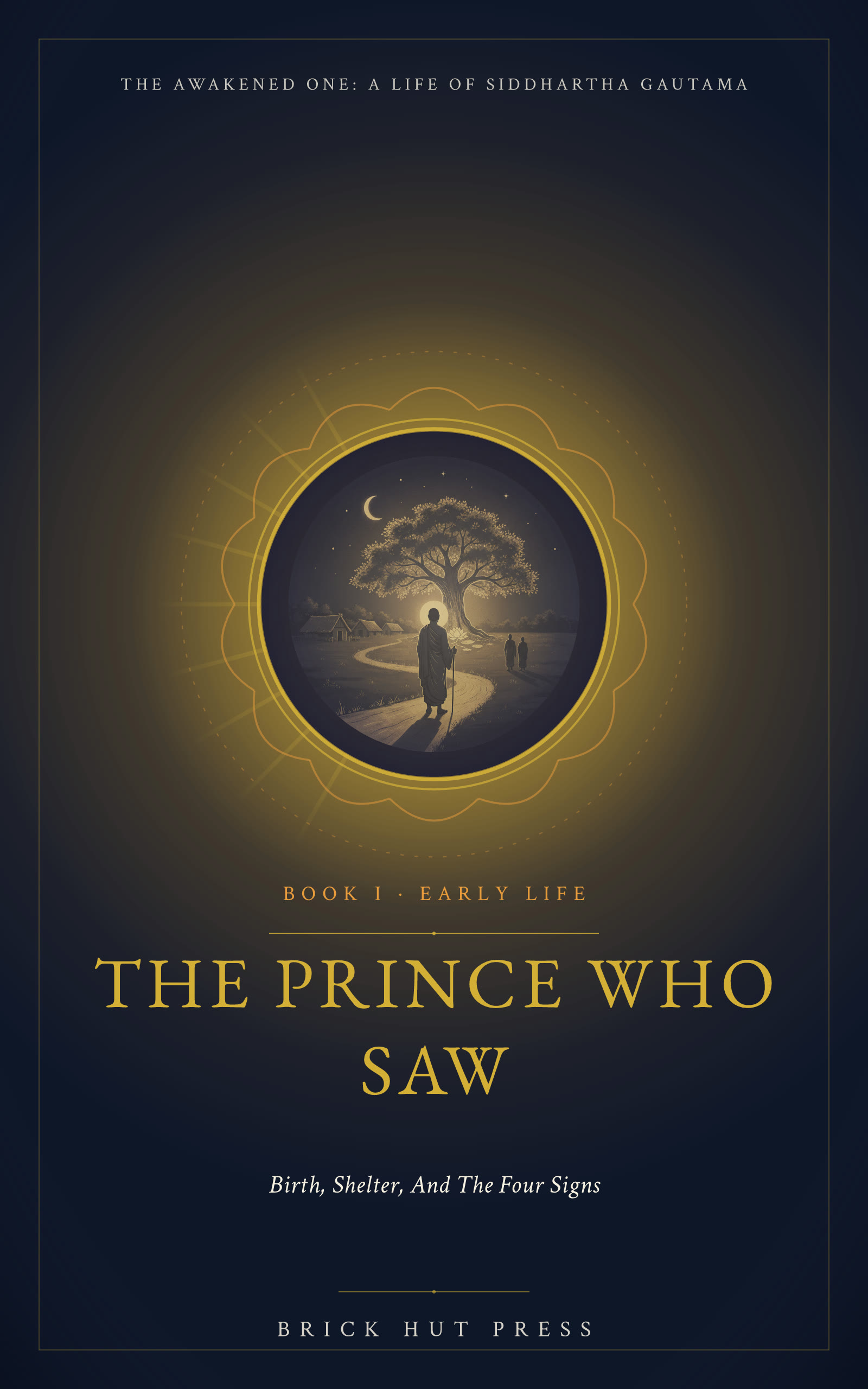
Lives that walk beside Siddhartha Gautama, chosen for their likeness, not their fame.