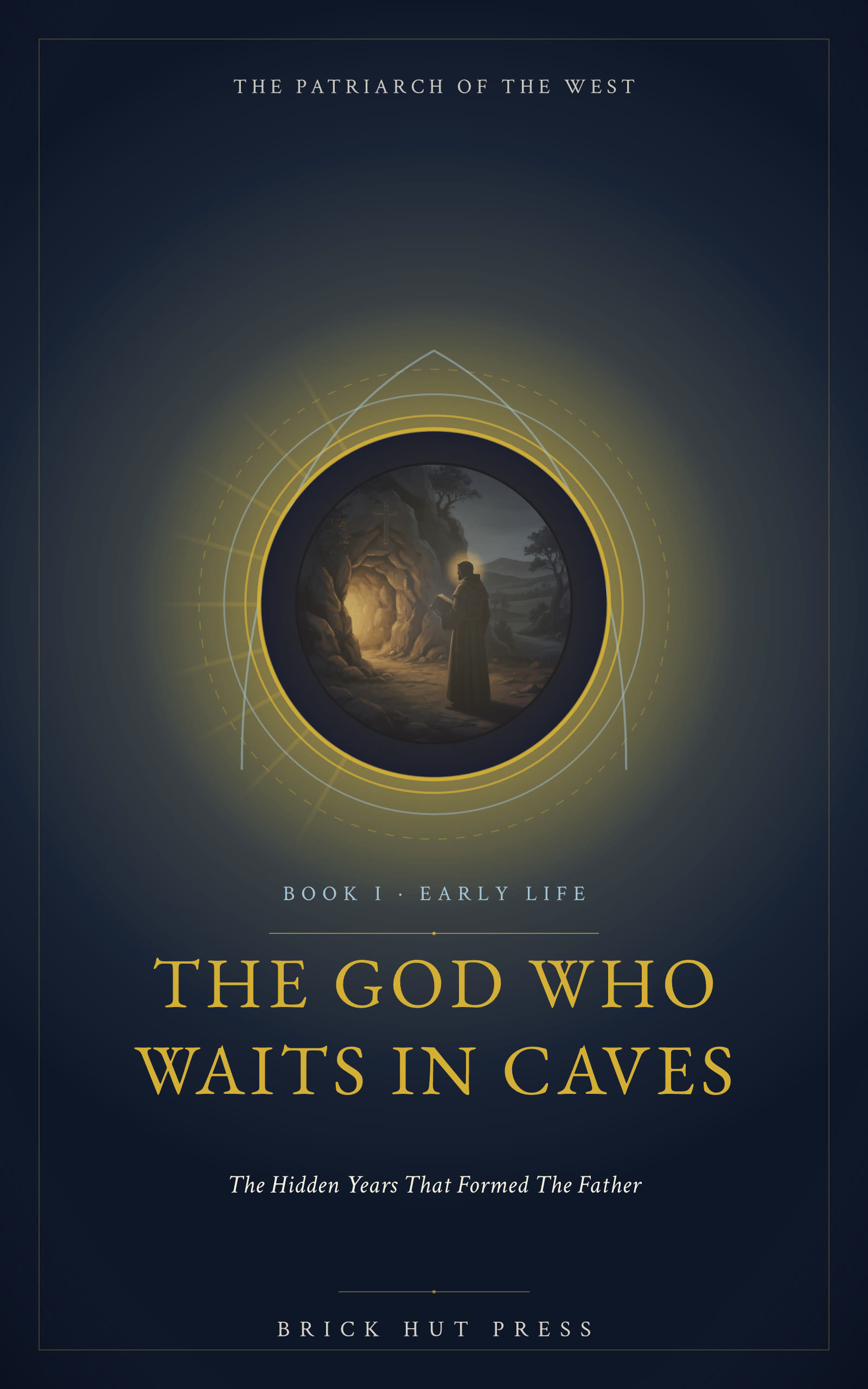
The God Who Waits in Caves
Before Benedict Built a Rule, a Cave Built Benedict. What happens in the silence before greatness? Most histories of Saint Benedict begin at Monte Cassino, the monastery, the Rule, the legacy that shaped Western civilization. This book begins earlier, and goes deeper. It enters the cave at Subiaco, where a young Roman nobleman, fleeing the corruption of the city, disappeared into three years of radical solitude. Those hidden years are where the real story lives.
Read the full description
And they are the years most often skipped. The God Who Waits in Caves recovers those lost seasons with warmth, reverence, and spiritual honesty. Drawing on ancient sources and the living tradition of Benedictine spirituality, this is the story of how God forms a soul not through triumph but through hiddenness, through failure, hunger, temptation, and the slow, patient work of grace in a man willing to wait. It is formation before fame. Silence before speech. The monk before the Rule.
About this volume
Before Saint Benedict was the father of Western monasticism, the lawgiver whose Rule would order the days of monks for fifteen centuries, he was a boy from a mountain town who walked away from everything Rome offered him and disappeared into a hole in the rock above Subiaco. This first volume of a three-part life stays with him there, in the years before the greatness, when he was no one's patriarch and nothing was yet certain, not even, some days, whether he would live.
The book opens in Nursia itself, at that startling elevation in the Sabine-Umbrian highlands where the air already seems to hold its breath, and it insists that geography is not incidental to sanctity. A child raised at two thousand feet, in a town whose old reputation was for flinty, unsentimental virtue, absorbs something of that hardness before he ever chooses it. From there the volume follows the shape his early life actually took: a twin sister whose presence is felt more than explained, the pull of Rome and its schools, and then the hinge on which the whole life turns, the moment he simply turned away from what the city promised him. Readers who know only the later Benedict, the abbot of Monte Cassino handing down a Rule, will find here the harder and stranger story of how a young man arrived at that refusal in the first place.
The heart of the volume is the cave. Chapters on Enfide, on the monk Romanus who fed him in secret, on the three years spent in the dark above Subiaco, take seriously what it cost to disappear, the physical hunger, the near-anonymity, the long stretch of time in which nothing visibly happened and everything was, in fact, being formed. This is not treated as a picturesque prelude to be hurried past on the way to the founding of monasteries. The book argues, gently and at length, that the cave was not an interruption of Benedict's vocation but its foundry, and that the discipline later codified in the Rule was first written, wordlessly, into the silence of those years.
What follows is the difficult transition out of hiddenness: the shepherds who stumble onto him, the abbacy he is pressed into and should perhaps have refused, and the community of twelve small houses he raises on the hillside above the Anio. The volume does not soften the resistance he met. A chapter is given plainly to the priest who hated him, and the poisoning that resistance is said to have attempted, not as scandal, but as an honest reckoning with how sanctity is often first received: with suspicion, envy, and outright hostility from those closest to it. This is a life shown working itself out among real antagonists, not in some frictionless spiritual vacuum.
The volume closes at Monte Cassino, on a hill that for centuries had known only the worship of Apollo, and asks what it meant for Benedict to plant something wholly new on ground so old. The final chapter, "What the Cave Had Always Been Making," gathers the threads deliberately: the boy from Nursia, the years of hidden formation, the reluctant abbot, arriving at last at the place where his life's second and larger work will begin, a work this volume sets up but does not attempt to finish, leaving the Rule itself and its long inheritance to the volumes that follow.
Written from inside the conviction that holds Benedict as father and patriarch, this is a book for readers who want the formation before the fame, who want to stand, as the author has stood, on the plain below Norcia in early March, and feel the particular silence out of which a saint was made.
Not sure yet? Begin freely.
The Father Who Stayed, a complete portrait of this life, free, kept in your own library here. The door into all 3 volumes.
Receive the free book →
Lives that walk beside Saint Benedict of Nursia, chosen for their likeness, not their fame.