The Child the River Knew
Before the Philosophy, There Was a Child the River Chose A mother bargained with Shiva. A crocodile closed its jaws. And a boy stepped out of an ordinary Kerala childhood into a destiny that would reshape the spiritual map of an entire civilization. This is the story you have always sensed behind the commentaries, the human fire burning underneath Advaita Vedanta's luminous abstractions. The Child the River Knew brings you into that fire.
Read the full description
Long before Adi Shankaracharya became the Jagadguru, the teacher of the world, he was a boy in Kaladi, born of a mother's desperate prayer, raised in the shadow of grief, and pulled toward the roaring of something vast and wordless that no village life could contain. This is his beginning, told from inside the warmth of the living tradition: the birth, the boyhood, the blazing moment of awakening, and the long road north that began beside the sacred Narmada.
About this volume
This is the volume where the river first learns the child's name.
Before Adi Shankaracharya was the reformer who would walk the four directions of Bharat and re-establish the unity of the Vedas against a bewildering age of contending schools, he was a boy in Kalady whose mother had asked the Lord of Kailasa for a son and had been answered, and this book begins there, in the cold hour before temple bells, with Aryamba's japa on the riverbank and a longing that the tradition never asks us to soften or minimize. From that opening chapter, "What Aryamba Asked of Shiva," the volume moves with unhurried attention through the village of Kalady itself, a place that held, as our title has it, a star without knowing it, an ordinary Nambudiri settlement on the Periyar that would become, forever after, a name spoken with folded hands across the Sanatana Dharma world.
The middle chapters take up the boyhood proper: the upanayana that marked Shankara's formal entry into Vedic study, and the unsettling, luminous fact, treated here with the seriousness it deserves rather than as mere hagiographic flourish, that the boy seemed already to know what he was being taught before it was taught to him. This volume does not shy from the grief that shaped him either. "The Day the Shadow Fell" sits at the center of the book, recounting the loss of his father Shivaguru and what that absence asked of a household and of a child too young, by any ordinary reckoning, to carry it. And "The Burning in His Chest" follows close behind, naming directly the vairagya, the world-weariness, the fire of renunciation, that had already begun to move in him long before he had words fit to explain it to his mother.
The famous crossing comes next, and readers who know the story only in outline will find here the fuller weight of it: the crocodile, the river, and the vow extracted from a mother's yes that could not, in the end, be withheld. It is a scene the tradition has always understood as more than incident, it is the hinge on which a boy's private awakening becomes a mother's blessing to leave, and the chapter that follows, "The Last Night in Kalady," sits with the tenderness and the finality of that departure without rushing past it.
From there the volume turns north and outward. "The Long Walk North" and "The Cave Above the Narmada" carry the boy-sannyasi out of Kerala and into the company that would shape everything after: the meeting with Govindapadacharya, and through him, the living transmission of Gaudapada's vision, the Mandukya-karika lineage that gave young Shankara the philosophical bones on which he would later build the great commentaries. These chapters treat that meeting not as a folk legend but as the true axis of the volume, the moment the personal fire of a grieving, searching boy is received into the discipline and clarity of an unbroken guru-parampara.
The book closes where every serious student of Advaita Vedanta will want it to close: with the first compositions, the earliest stirrings of the voice that would soon compose commentary the entire tradition would stand on, and with Govindapadacharya's blessing and charge, go and save the world, which turns this volume of boyhood into the threshold of everything Bhagavatpada Acharya would become. Readers coming to this series for the first time will find here not a summary of miracles but a patient, reverent account of formation: a child, a river, a mother's yes, and a lineage waiting to receive him.
Not sure yet? Begin freely.
The Boy Who Remembered Brahman, a complete portrait of this life, free, kept in your own library here. The door into all 3 volumes.
Receive the free book →
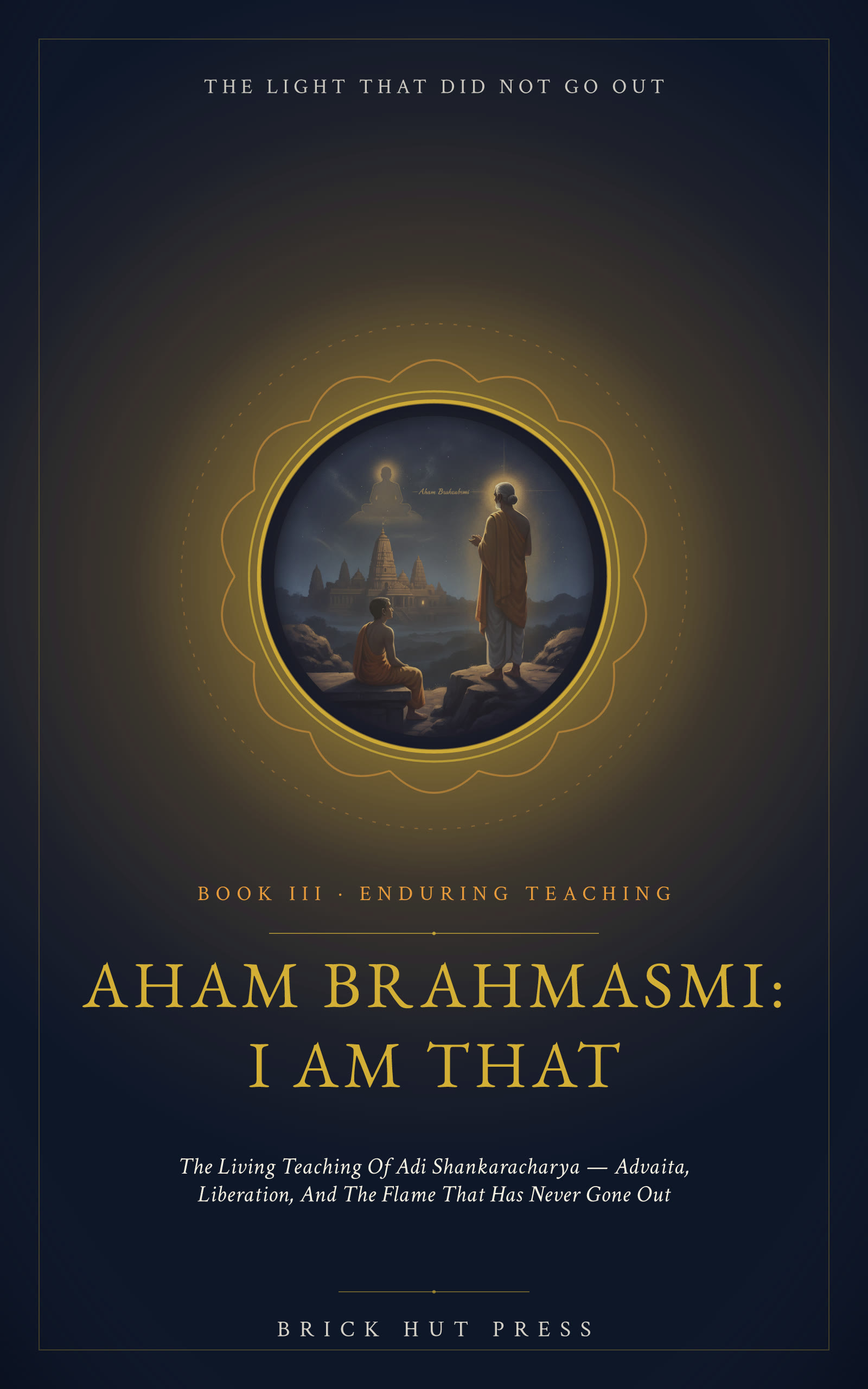
Lives that walk beside Jagadguru Sri Adi Shankaracharya, chosen for their likeness, not their fame.