He Walked Until India Remembered Itself
He Walked Until India Remembered Itself A staff. A thirty-two-year-old monk. And the soul of an entire civilization waiting to be rekindled. Adi Shankaracharya did not simply travel India, he walked straight through its confusion, its fragmentation, and its forgetting, and left behind a living fire that burns to this day. This is the story of that walk.
Read the full description
The Digvijaya, the great all-India pilgrimage of debate, conversion, and dharmic renewal, is one of the most extraordinary journeys any human being has ever undertaken. Armed with nothing but a staff and the totality of Vedic wisdom, Shankara crossed mountains and river-plains, stood before the most formidable scholars of his age, and drew the wandering streams of Indian spiritual life back toward their non-dual source. He was thirty-two years old. He had perhaps eight years left to live. And he changed the subcontinent forever. He Walked Until India Remembered Itself accompanies the Acharya step by step, through the legendary debates, the gathering of disciples, the founding of the eternal Mathas, and the moments of grace that no biography of dates alone can capture. Told with the warmth and reverence of a living tradition, this book is not merely history. It is an invitation to witness the Shankaracharya face-to-face.
About this volume
The first volume of this life left the young Acharya at the threshold of his mission, the boy from Kalady formed by Govindapada's cave, sent north to save the world. This second volume is the world he saved. It is the book of the road itself: the digvijaya, the "conquest of the directions," in which a young sannyasin with a water pot and two pieces of cloth walks into the most learned city on earth and, without asking to be noticed, becomes the axis on which Indian thought turns.
The volume opens in Kashi precisely because Kashi will not simply hand him its attention, the chapter is careful to show a city too old and too dignified to be impressed by reputation, so that what follows must be earned in argument, not granted by fame. From there the book moves with real architectural patience through the events that scholars of the tradition have long regarded as the hinge of the entire Advaita revival: the completion of the great commentaries that answered the intellectual crises of the age, and then the debate at the house of Mandana Misra, which this volume treats not as legend-decoration but as the central drama of the book, days of formal disputation on karma and jnana, ending in a conversion that gave Advaita one of its sharpest future voices in Sureshvara. Readers who have wondered how Ubhaya Bharati's famous challenge fits into serious hagiography will find it handled here with full seriousness: the goddess-wife testing the teacher on a subject sannyasa had closed to him, and the strange, humbling detour that followed.
Around this central debate the volume gathers the disciples who would carry the teaching forward, Padmapada, Totakacharya, Hastamalaka, each given a chapter that treats their arrival not as a footnote but as its own small revelation: the disciple who is said to have walked on water, the verse that came as pure grace rather than composition, the child who had never forgotten what most souls spend a lifetime remembering. These are not ornamental miracle-tales inserted for color; the book presents them as the tradition itself has always understood them, as evidence of what happens when the teaching lands in a soul already prepared, and it lets the reader sit with that claim rather than explaining it away.
The volume also makes room for the gentler register of Shankara's genius, the Kanakadhara episode, where compassion for a poor household is said to have moved the very sky, and the Soundarya Lahari, read here as what it has always been to devotees: a love letter to the Absolute in the form of the Goddess, proof that the philosopher of nirguna Brahman could write with the tenderness of a bhakta. These chapters exist to correct a common misreading of Shankara as pure logician; this book insists, gently and repeatedly, that the intellect and the heart were never separate projects for him.
It closes where the tradition says the work of unification had to close: with the founding of the four Amnaya Mathas at the four corners of the land, the Panchayatana that gave quarreling sects a single room to worship in without surrendering their chosen forms, and finally the ascent northward through Kashmir toward Kedarnath. The final chapter does not linger on conclusions; it lets the road itself be the argument, the same road this whole volume has followed from the ghats of Kashi outward, until the reader understands what "digvijaya" actually meant, not conquest by force, but a country slowly, argument by argument, remembering what it already knew.
This is a book for readers who want the great debates rendered with their full stakes intact, who want the disciples treated as living presences rather than names in a lineage list, and who are prepared to meet miracle and metaphysics side by side, as the tradition itself has always kept them.
Not sure yet? Begin freely.
The Boy Who Remembered Brahman, a complete portrait of this life, free, kept in your own library here. The door into all 3 volumes.
Receive the free book →
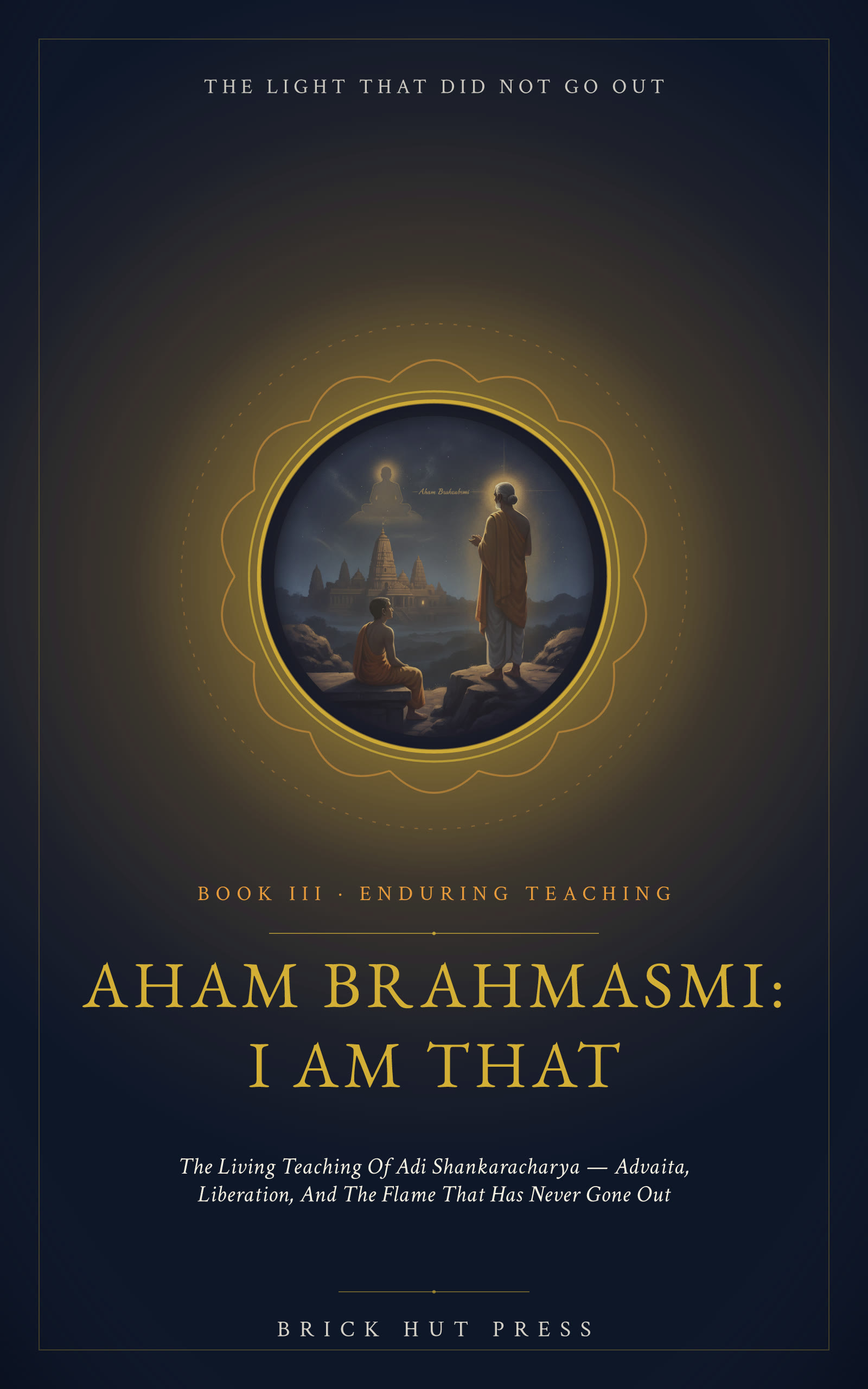
Lives that walk beside Jagadguru Sri Adi Shankaracharya, chosen for their likeness, not their fame.