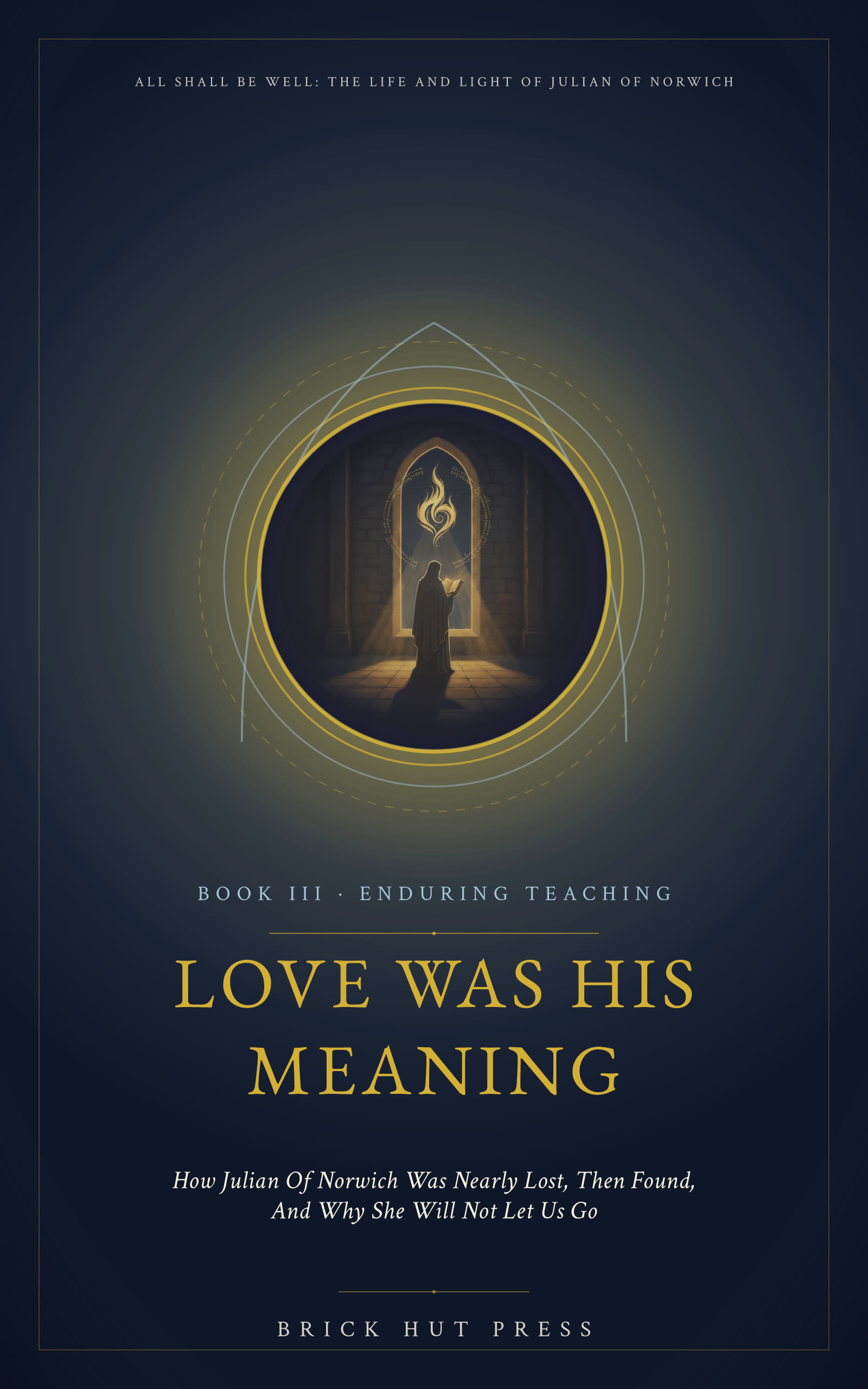
Love Was His Meaning
They were smuggled across the sea, hidden in cellars, preserved by trembling hands in an age when the wrong words could mean death.
She Was Nearly Lost to History, and She Has Never Been More Needed Her manuscripts were copied in secret. They were smuggled across the sea, hidden in cellars, preserved by trembling hands in an age when the wrong words could mean death. For centuries, Julian of Norwich was almost no one, a name scratched in an anchorite's register, a voice sealed behind a stone wall. Then the world found her again. And she will not let us go.
Read the full description
Love Was His Meaning tells the full, astonishing story of how this fourteenth-century mystic and anchoress, who received sixteen showings of divine love during a near-fatal illness and spent the next twenty years meditating on what they meant, became one of the most beloved spiritual voices in Christian history. It traces her journey from the silence of her cell in Norwich to the hearts of contemplatives, seekers, and the simply desperate on every continent. And at the center of it all stands her great, unshakeable declaration: Love was his meaning. Who shewed it thee? Love. What shewed he thee? Love. Wherefore was it shewed? For Love.
Not sure yet? Begin free.
All Manner of Thing, a complete book about this life, free, kept in your own library here, read now; its narration joins free when it is finished.
Receive the free bookAbout this volume
This third volume of All Shall Be Well takes up a story the first two books could not tell, because it is not the story of Julian of Norwich's life at all. It is the story of what happened after her name stops appearing in the records, and of how a woman who seems to have died in near-total obscurity became, across six centuries, one of the most beloved voices in the Christian mystical tradition. Love Was His Meaning begins at the silence itself: the 1416 bequest from Isabel Ufford that is the last documentary trace of the anchoress of St Julian's church, and the long unmarked gap that follows, no burial record, no successor named for her cell, no account of her final hours. From that absence the volume builds its arc forward, tracing how her Shewings survived at all, and why they did not stay buried with her.
The middle chapters follow the fragile chain of custody by which Julian's words crossed centuries that could easily have lost them. We meet the religious women, generations removed from Norwich, who carried her manuscript across the Channel into continental exile, keeping it alive in community when England itself had little use for an anchoress's visions. We meet Serenus Cressy, the seventeenth-century monk who gave her first printed form to the world, and later Grace Warrack, whose Edwardian edition opened Julian's Middle English to readers who had never heard her name, and whose work did more than any single act since Cressy's to put the book back into circulation. These are not footnotes; the volume treats them as the hinge points without which there would be no Julian to read today, each one a small act of fidelity performed by someone who never knew her and owed her nothing.
From there the book turns to the twentieth century and to the poets and monks who heard her voice as though it were contemporary. A chapter is given to the poet who received her across six hundred years as a living presence rather than a historical curiosity, and another to Thomas Merton, who found in his own cell an echo of hers, two solitaries separated by centuries recognizing the same ground beneath their feet. The volume follows the rebuilding of her shrine at Norwich and the living community that gathers there now, people who come not as tourists to a ruin but as pilgrims to a presence still felt. It also takes seriously the scholarly reclamation of Julian as theologian in her own right, not merely a devotional curiosity but a thinker whose categories of sin, suffering, and divine motherhood have earned a serious hearing in the modern academy.
The last third of the book turns from history to substance, asking what exactly Julian has to teach a reader standing in prayer, in doubt, or in grief. Chapters on the ground of beseeching, on what sin could not undo, and on her famous assurance that we shall not be overcome take her revelations on their own terms, letting them speak as spiritual instruction rather than as artifacts. A chapter on the hazelnut, that small round thing held in the palm of a hand, small as our whole created world, draws together the volume's quieter argument: that Julian's survival across the centuries is not an accident of manuscript history but a continuation of the very love she described, a love that does not let go of what it holds.
The final chapter, which gives the book its title, returns to the question Julian herself asked near the end of her Shewings and answered simply: what was his meaning. This volume does not claim to add anything to her answer. It only tries to show, through the long and often precarious history of her survival, how thoroughly that answer has already been received, carried, printed, translated, prayed with, and lived, by far more hands than she could have imagined kneeling in her small cell against the church wall at Norwich.


Lives that walk beside Julian of Norwich, chosen for their likeness, not their fame.