Enclosed in Endless Love
In the fourteenth century, a woman asked to be sealed inside a tiny room attached to a church in Norwich, no grand exit, no return to the world.
She Was Walled In. And From That Silence, She Changed Everything. In the fourteenth century, a woman asked to be sealed inside a tiny room attached to a church in Norwich, no grand exit, no return to the world. A ceremony resembling a funeral rite was read over her. The door was mortared shut. And there, in that sacred enclosure, Julian of Norwich wrote the first book in English known to have been composed by a woman. Not a whisper of complaint survives. Only wonder.
Read the full description
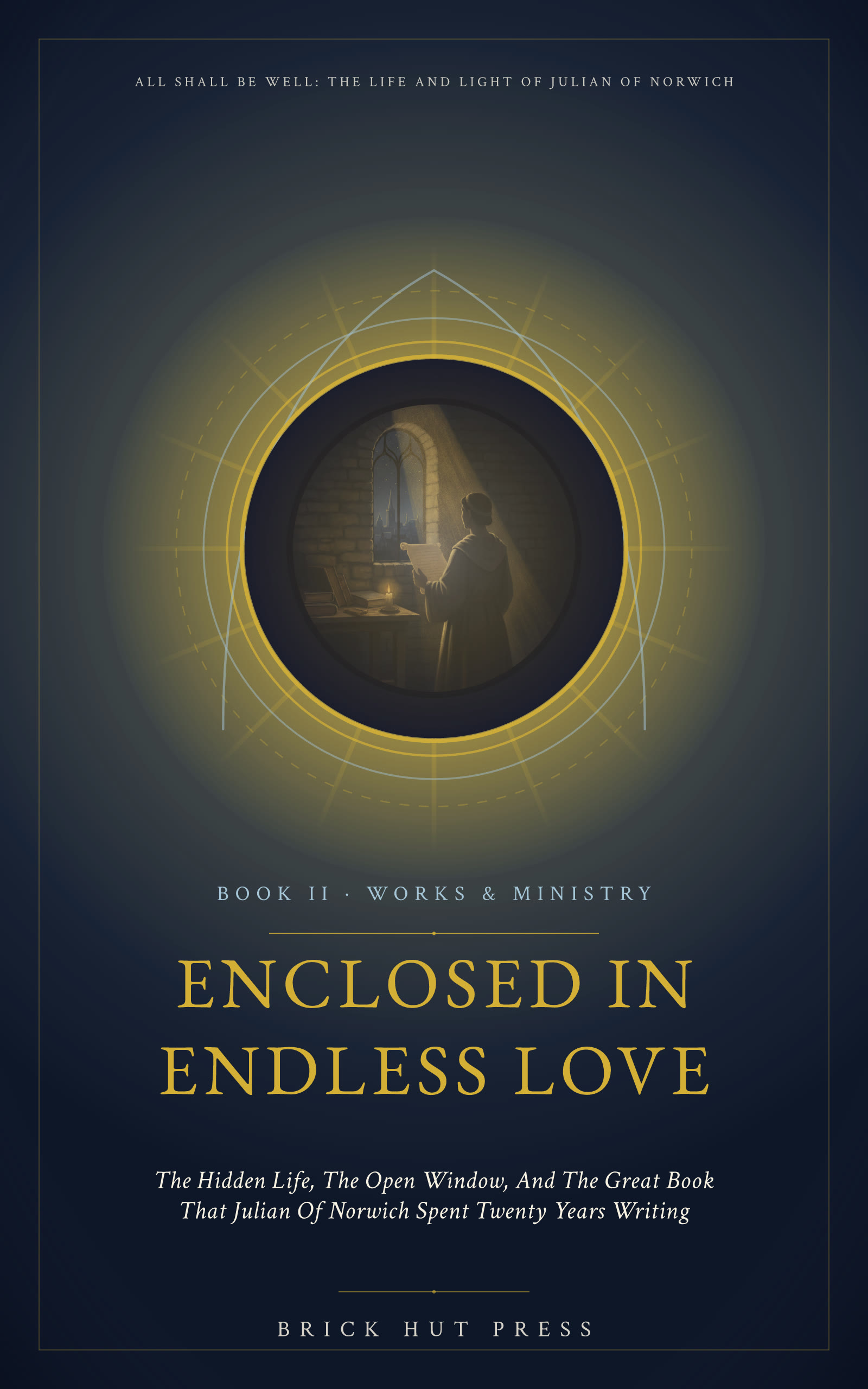
Enclosed in Endless Love takes you into that cell, its rough stone walls, its tallow-candle light, its single window opening onto a world she had formally left behind. This is the story of how a woman transformed a fever-bed vision into twenty years of patient, fearless theological reflection, and why the book she produced still stops readers cold with its tenderness and its audacity.
Not sure yet? Begin free.
All Manner of Thing, a complete book about this life, free, kept in your own library here, read now; its narration joins free when it is finished.
Receive the free bookAbout this volume
This is the second volume of All Shall Be Well, and it takes up Julian of Norwich at the hinge point most lives of her skip past too quickly: the gap between the woman who nearly died in May of 1373 and the anchoress whose book would outlast her by six centuries. Volume One gave the visions themselves. This volume asks what Julian did with them once the fever broke, the room went quiet, and she had to decide what a vision is for.
The book opens with the Short Text, the raw account written while, as the opening pages put it, the ink was fresh and the wax on the visions had not yet cooled. From there it moves into the rite of enclosure itself, the formal ceremony by which Julian became an anchoress at St. Julian's Church in Norwich, a ritual the volume treats with the gravity it deserves: a woman buried, liturgically, in order to live more fully. Chapter Three turns to the architecture of that enclosed life, the three windows of the anchorhold, one opening onto the altar, one onto a servant, one onto the street, and asks what it meant for a woman walled into stillness to remain, through that single street-facing window, so thoroughly available to the world. Chapter Four follows the people who actually came to ask for her counsel, because Julian's enclosure was never a retreat from Norwich so much as a repositioning within it.
The heart of the volume is the twenty years. Chapter Five sits with Julian's own admission that she did not yet understand what she had seen, and the book refuses to rush past that confession toward easy resolution. It treats not-quite-understanding as a discipline in itself, the slow interior labor by which showings become theology. Out of that labor come the two teachings for which Julian is most loved and most argued over: the startling, tender naming of Jesus as Mother, taken up fully in Chapter Six, and the haunting assurance, worked through in Chapter Seven, that sin is behovely and all shall be well. Chapter Eight follows the thread further still, into Julian's vision of a great deed that God shall do at the end of time, a promise she holds without ever explaining it away.
The second half of the volume turns to the Long Text itself, the book Julian finally set down after two decades of prayer and reflection, and the famous Parable of the Lord and the Servant, which the volume treats as something like the key Julian herself found late, the image that let her reconcile divine love with human falling. From there the chapters widen out to Julian's reputation in her own lifetime, including the visit of Margery Kempe, the Lynn mystic whose own account of coming to Julian's window gives us one of the only outside glimpses of the anchoress at work. The volume closes gently, with Julian still there in her last years, the window still open, the book still being read by those who sought her out.
Readers who come to this volume should expect patience rather than spectacle. There are no new miracles here, no dramatic turns; there is instead the far rarer story of a mind and a soul working slowly, faithfully, for twenty years, toward words simple enough for a child and deep enough to still startle readers six hundred years on. For anyone who has ever sat with a hard truth long enough to find, underneath it, an unshakeable tenderness, this is a book about what that patience can become.
Lives that walk beside Julian of Norwich, chosen for their likeness, not their fame.