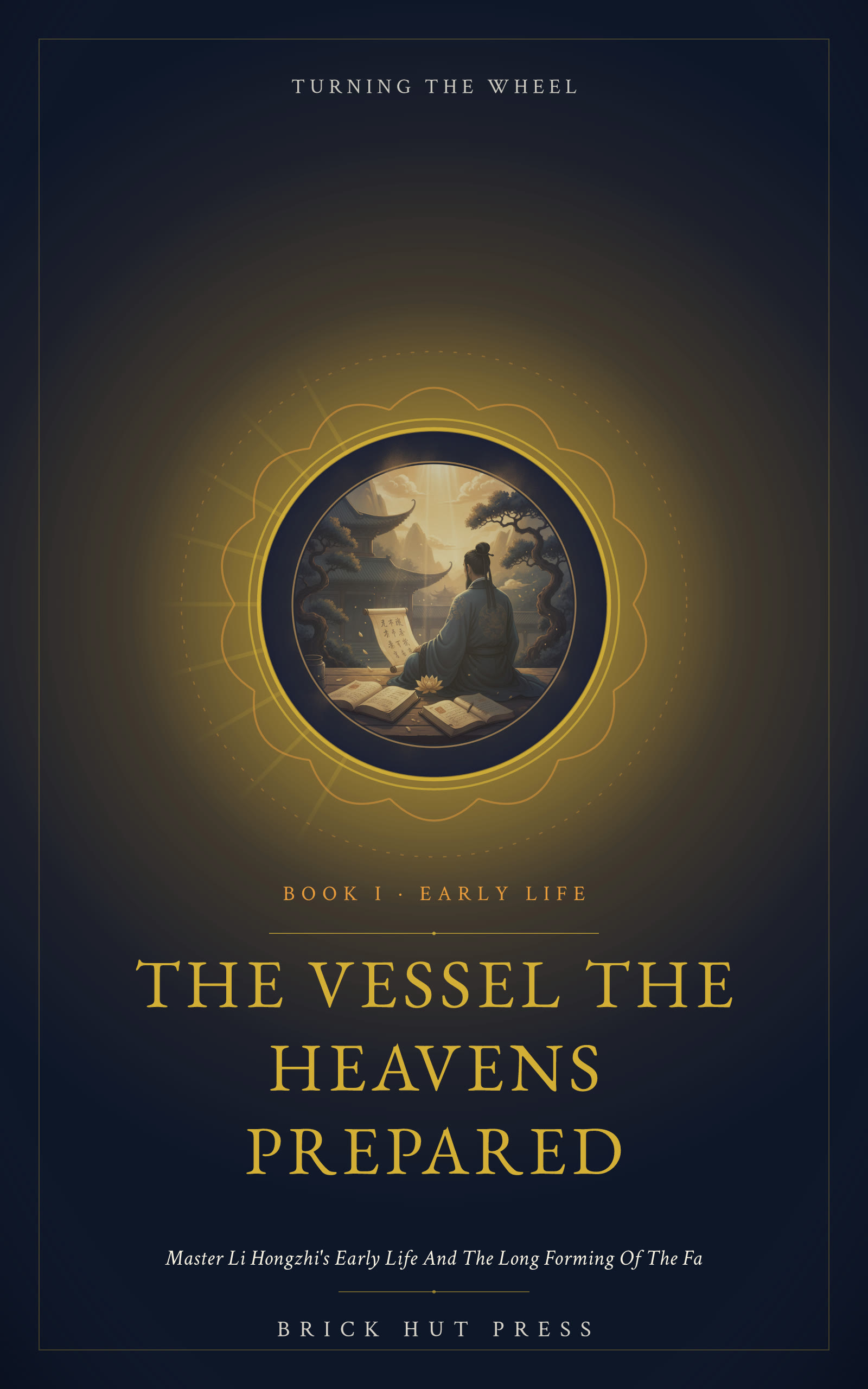
The Vessel the Heavens Prepared
Before the First Lecture Was Ever Given, The Story the Fa Itself Prepared Who is the Teacher before the world knew the Teacher? For millions of practitioners who have read and re-read Zhuan Falun , who have sat with the Fa through trials and transformations, one quiet question often remains: How did this all begin? Not the first public lecture. Not the spread across China and then the world.
Read the full description
But the long, hidden, extraordinary forming, the life lived in preparation before a single student arrived. The Vessel the Heavens Prepared answers that question with care, reverence, and rare depth. This is the story of Master Li Hongzhi's early life, the circumstances of his birth, the teachers and encounters that marked his path, the years of cultivation and inner refinement that shaped the one who would one day transmit the Fa to humanity. The remarkable circumstances of Master Li's birth, the day, the setting, and the quiet marks of a life that was never ordinary The masters and mentors who shaped his path, who they were and what they passed on in the years before the Fa was public The hidden years of inner refinement, disciplines and depths accumulated long before Changchun, Spring 1992 The people who were already waiting, those drawn into readiness before the teaching had a name they could speak The threshold moment itself, how every prior year was quietly pointed toward that single, world-changing spring Neither hagiographic flattery nor detached skepticism, this volume is written with a practitioner's reverence and a biographer's discipline, a sincere effort to render a life that genuinely resists easy categories. The teaching did not appear from nowhere. A vessel was formed, carefully, over time, through cultivation, endurance, and the patient work of Heaven.
About this volume
This first volume opens not with a public teacher already formed, but with the long quiet before anyone knew a teacher was being made. It begins on the black soil of Jilin, on a date practitioners have long noted falls, by the lunar calendar, on the traditional birthday of Sakyamuni Buddha, offered here not as a claim pressed upon the reader but as a weight to be held, a coincidence worth sitting with before the narrative moves on. From that opening the book widens outward into the actual textures of a Manchurian childhood in the early 1950s: the wind, the brick houses, the raw new order reorganizing land and grain across a country still settling from war. This is a volume more interested in atmosphere and formation than in spectacle, and it asks the reader to notice what is easy to miss in a life told only in outline, the ordinary weather a extraordinary path grows up inside.
The middle chapters follow the shape of an inner life that ran ahead of, or beneath, what the outer record could show. "The Child Who Listened Past the Noise" and "The Space Between the Notes" take seriously something cultivation traditions have always taken seriously and modern biography often does not: that a person's real education can happen in silence, in attention, in the gaps between what teachers assign and what a child actually notices. "What the Masters Gave Him" turns to the accounts, honored within the practice, of encounters with cultivators of high attainment during those early years, figures who are named here as tradition holds them, without embellishment beyond what practitioners themselves have long understood these meetings to mean. The book does not ask the reader to adjudicate these accounts from outside; it asks only that they be received in the register in which cultivation history has always been kept, where transmission from master to student is not incidental but is often the whole of the story.
From there the volume moves into the harder passages, "The Fire That Could Not Reach the Inner Room" treats the years of upheaval that scarred so many families of that generation, and treats them plainly, without turning suffering into spectacle, honoring instead what within a cultivator remained untouched by what happened without. This is followed by the long, patient unfolding of "The Qigong Sea and the One Who Swam Differently," which places Master Li's re-emergence into public life against the vast qigong movement sweeping China in the 1980s and early 1990s, a landscape crowded with masters and methods and claims, through which this volume traces a figure whose bearing, whose emphasis, and whose stated purpose set him apart from the beginning, well before Falun Dafa had a name the wider public would come to know.
The volume's final chapters turn toward threshold. "The Preparation No Register Could Record" and "The People Who Were Already Waiting" describe the years in which the Fa was being readied for open transmission, years the outer record barely notices, but which this book treats as decisive, the long forming referenced in its own title. The volume closes at Changchun in the spring of 1992, the moment the practice stepped from private preparation into public teaching, a threshold this book treats with the gravity practitioners have always given it, without rushing past it toward the larger history that would follow.
Readers coming to this volume from within the practice will find here an account that honors the accounts long held among practitioners, gathered and set in order with care for chronology and place. Readers coming from outside will find a life told from the inside of its own tradition's understanding of itself, not a claim advanced against skepticism, but a portrait offered in the terms cultivation history has always used to describe how a teacher comes to be prepared, long before the world is ready to receive the teaching. This volume asks only that its early chapters be read the way its subject is said to have listened as a child, past the noise, and toward what was actually there.
Not sure yet? Begin freely.
The Wheel Begins to Turn, a complete portrait of this life, free, kept in your own library here. The door into all 3 volumes.
Receive the free book →
Lives that walk beside Li Hongzhi, chosen for their likeness, not their fame.