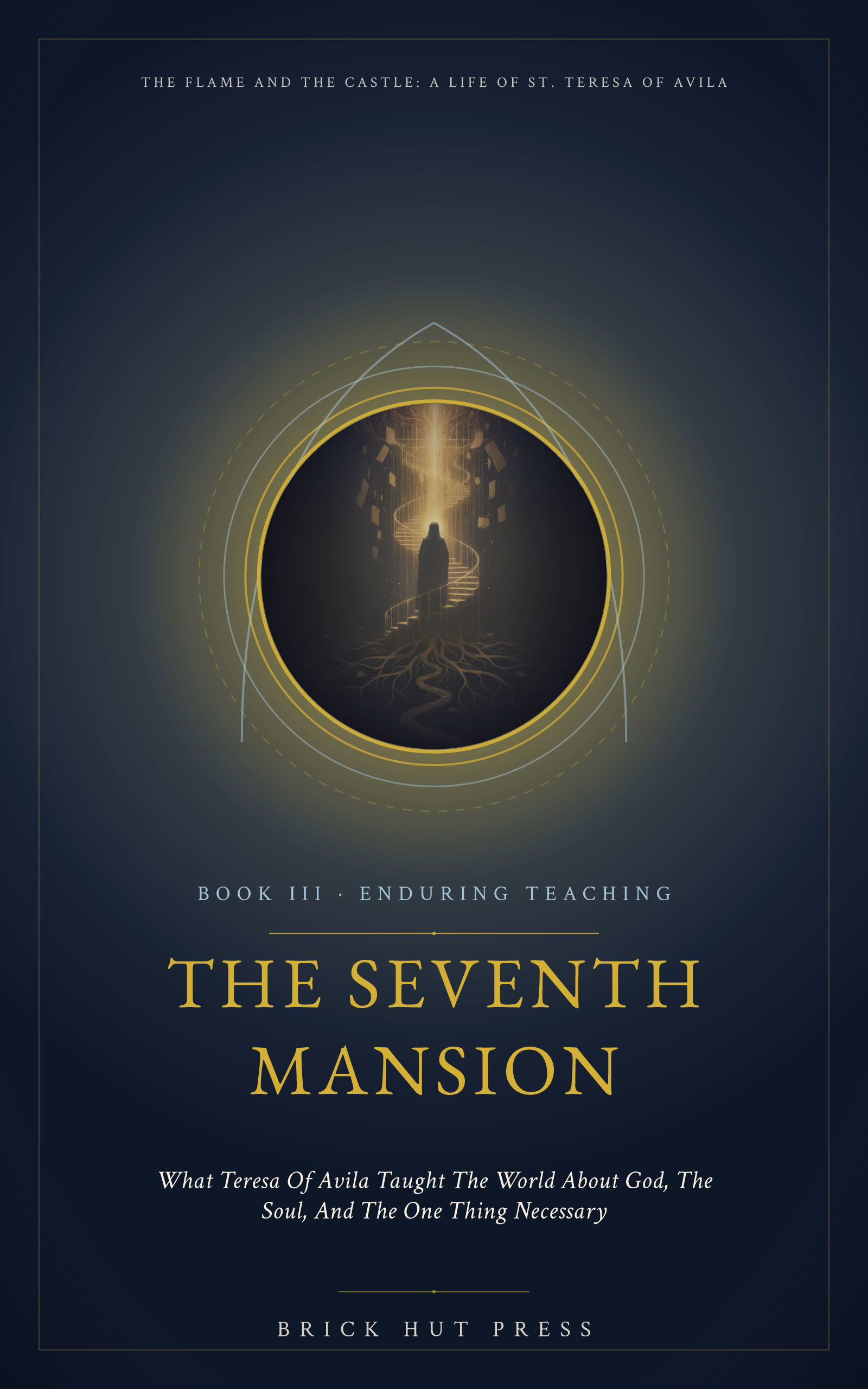
The Seventh Mansion
She Mapped the Soul's Deepest Rooms, and Left the Door Open for You Teresa of Ávila did not write theology from a library. She wrote it from her knees, from her visions, from the fire that pierced her heart and the silence that followed. For five centuries her words have led souls past distraction and dryness, past doubt and spiritual mediocrity, into the innermost chamber where God waits, not as an idea, but as a Presence.
Read the full description
The Seventh Mansion is your invitation to follow her there. This is not a summary of Teresa's teaching. It is an immersion in it. Written with warmth, rigorous fidelity to her texts, and a deep love for the contemplative tradition, The Seventh Mansion draws you inside the Interior Castle room by room, explaining not just what Teresa said, but what she meant , and what it means for your prayer life today. Whether you are just discovering this towering Doctor of the Church or have walked with her for decades, this book will take you further in.
About this volume
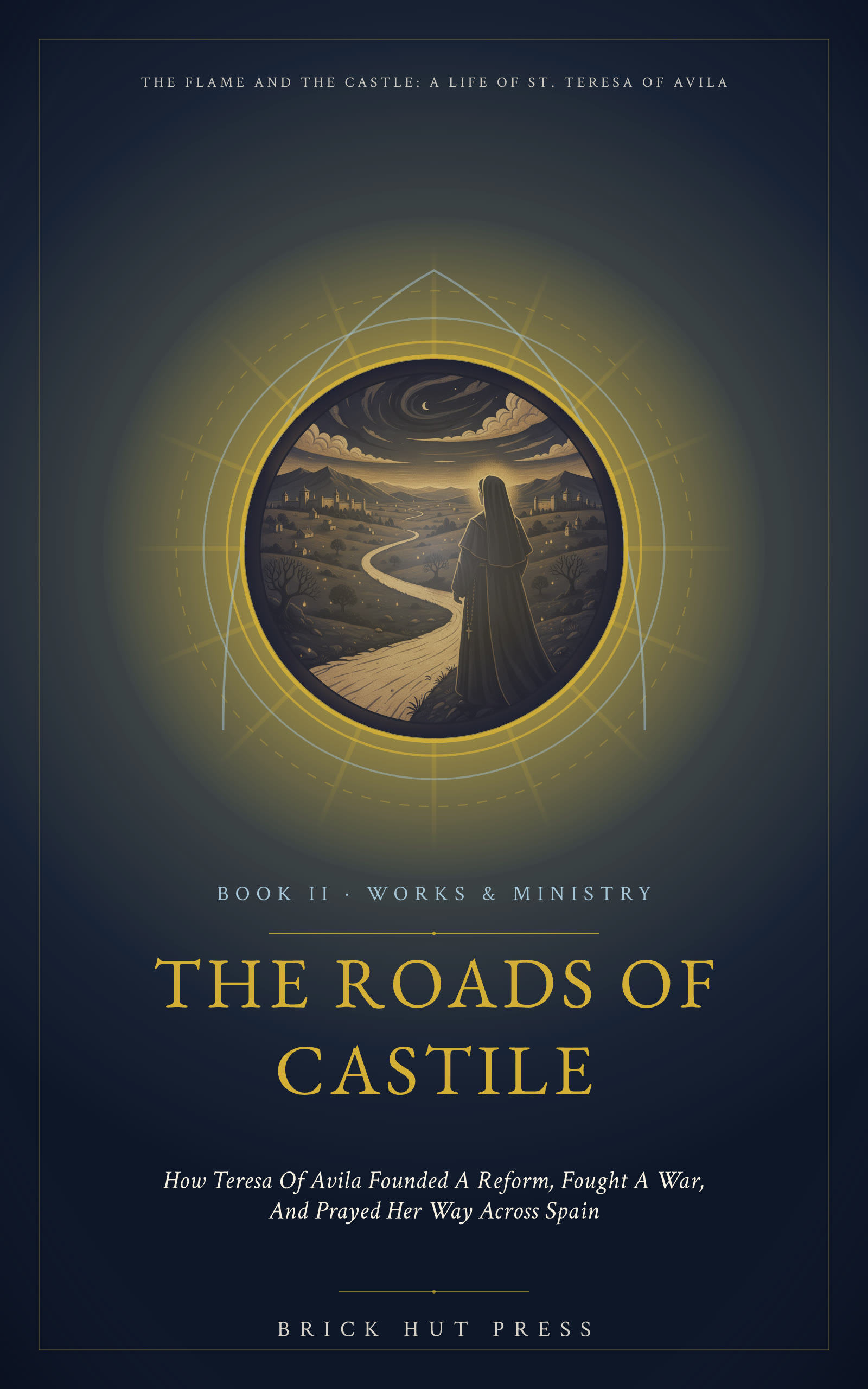
This is the third volume of The Flame and the Castle, and it is the volume that asks what remains once the roads are behind her, the seventeen foundations already standing, the mule-drawn cart already stilled, the long argument with bishops and confessors already, mostly, won. Where the first two volumes followed Teresa de Cepeda y Ahumada through the world, through Ávila's walls, through the reform of Carmel, through the dust of Castile, this volume follows her inward, into the rooms she herself named, and asks what she was actually trying to tell us about God, the soul, and what she called, with characteristic bluntness, the one thing necessary.
It begins where a life ends: in the cell at Alba de Tormes, on the night of October 4, 1582, with Anne of St. Bartholomew's arms around a dying woman murmuring psalms. From that candlelit room the book moves backward and inward at once, gathering up the images Teresa gave the Church to think with, the garden and its four waters, the interior castle with its seven mansions, the silencing of a restless mind in prayer, the betrothal she described not as metaphor but as event. Chapters on "The Woman Who Named What She Saw" and "Come Inside: The First Three Mansions" take seriously her insistence that she was reporting, not inventing, that she had gone somewhere and was trying, with the only words available to a sixteenth-century Spanish nun, to draw a map for those who might follow. This volume does not treat that map as literary ornament. It treats it as doctrine, hard-won and still standing.
The middle chapters slow down at the places where Teresa's teaching is hardest and most necessary: the silencing of the mind that is not blankness but attention, the betrothal that is not swoon but union, the innermost room that she reached and described and then, in her own words, found impossible to fully describe. "Nada Te Turbe", let nothing disturb you, receives its own chapter not as a decorative motto but as a teaching wrung out of a life that had every reason to be disturbed: illness, opposition, the Inquisition's watchful eye, the slow grinding resistance of a Church not eager to be reformed by a woman. The book asks what she meant by that famous serenity, and whether it was won cheaply or at enormous cost. The answer it gives is not comforting in the easy sense.
The volume's second half turns from the mystic to the aftermath, the body that would not decay, and what the faithful and the skeptical alike made of that; the long, complicated process by which the Church received her, tested her, and finally named her teacher; the strange fact that her convents kept multiplying long after her death, so that a chapter can honestly be titled "She Is Still Building." These chapters do not rush past controversy. They sit with the examiners who doubted her, the theologians who parsed her visions for heresy, the decades it took before Rome was ready to call a woman a Doctor of the Church. The book trusts that Teresa's own confidence in what she had experienced can withstand this scrutiny, because it always has.
It closes, fittingly, with "Friend", not a summary of doctrine but a return to the register in which Teresa herself most often wrote, the voice of a woman writing to people she loved, in convents she had built, about a God she insisted was found as easily among the pots and pans as in the highest mansion of the castle. Readers who have followed her through the earlier volumes will find here the payoff of that long companionship; readers meeting her for the first time in this book will still find a complete arc, from deathbed to legacy, that does not require the earlier chapters to be understood. What it requires is a willingness to take seriously a woman who claimed to have gone somewhere real, and who spent the rest of her life trying to leave the door open behind her.
Not sure yet? Begin freely.
A Heart Wide Open, a complete portrait of this life, free, kept in your own library here. The door into all 3 volumes.
Receive the free book →
Lives that walk beside St. Teresa of Avila, chosen for their likeness, not their fame.