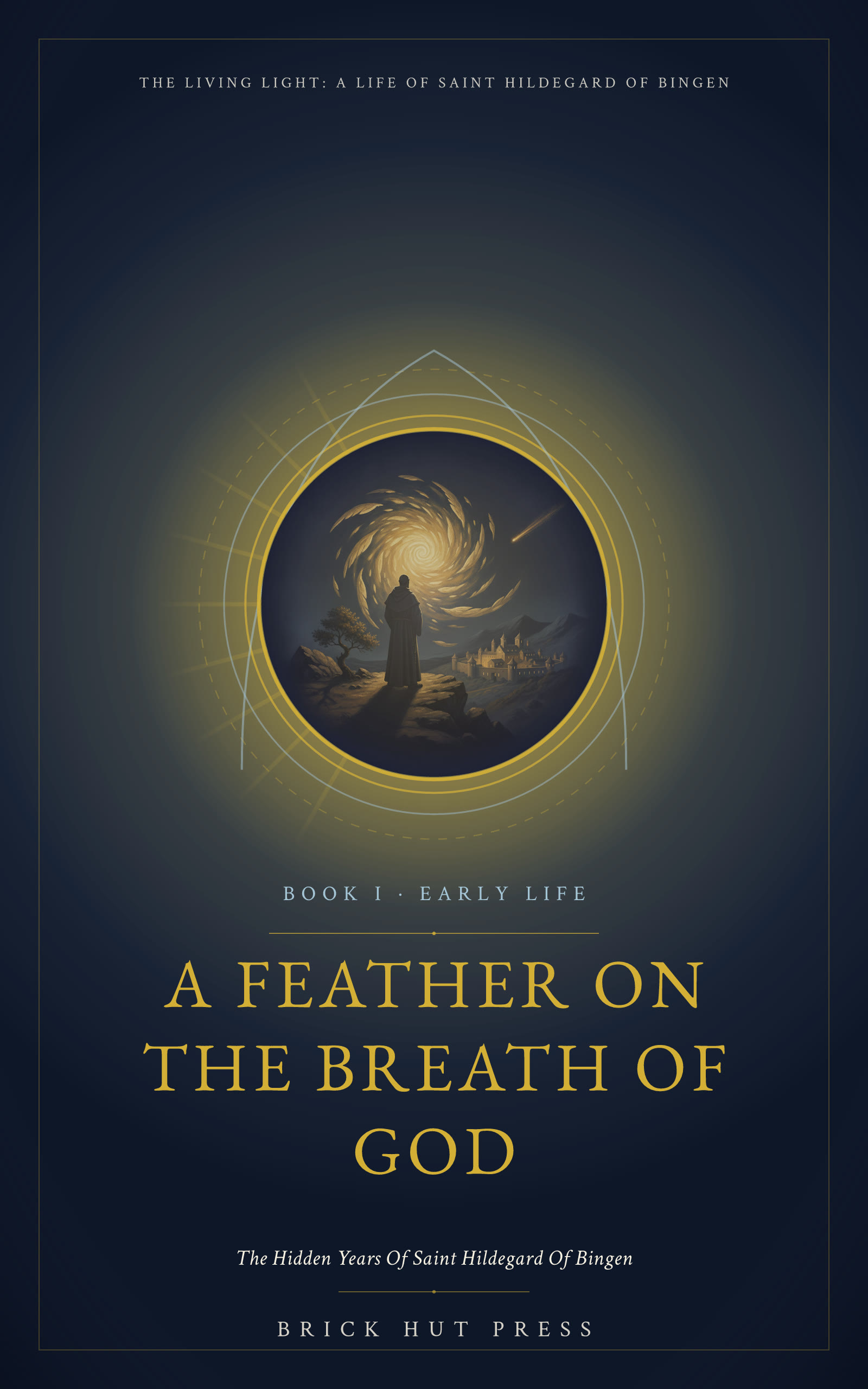
A Feather on the Breath of God
About this volume
Before Saint Hildegard of Bingen became the abbess whose letters instructed popes and emperors, before she was the composer of the Symphonia or the author of Scivias, she was a tenth child given away, a girl whose visions began, by her own late reckoning, almost as soon as she could speak, and whose parents answered the mystery of her seeing in the only way their age knew how: by walling her into silence. This first volume of The Living Light takes up exactly that unrecorded stretch of a life the tradition has always known mostly by its ending. It asks what it might have meant to be Hildegard before anyone called her Saint, before the visions had a name, before the world outside Disibodenberg had any reason to wonder about the girl behind the enclosure wall.
The volume opens at Bermersheim, in the modest, ledger-minded household of Hildebert and Mechthild, where a family with more children than inheritance to give them had already, by the time of Hildegard's birth, settled the futures of nine sons and daughters. The chapters that follow do not flinch from the strangeness of what happened next: a child who saw light moving inside ordinary things, offered by her parents as a tithe to God in the person of the anchoress Jutta, sealed into the anchorhold at Disibodenberg's edge in a rite the medieval Church understood as a kind of living burial. "The Anchor and the Gate" and "The Schoolroom at the Edge of the World" sit with this decision in its own terms, not as cruelty by modern lights, nor as triumph dressed up for hagiography, but as the way a noble family in Rhenish Hesse in the early twelfth century understood sanctity, service, and the disposal of a daughter who saw things no one else could see.
From there the book follows the slow, cloistered arithmetic of years: the anchorhold's growth into a small community of women gathered around Jutta's cell, the Rhine-country landscape of river, rock, and vineyard that would surface decades later in Hildegard's visionary writing, and the bodily costs of an enclosed life that "The Weight of the Body" takes seriously rather than spiritualizing away. Readers will meet Volmar, the monk whose attentiveness to the young Hildegard's inner life would matter enormously to what she eventually dared to write down, and they will sit with the death of Jutta, the woman who had, in every practical sense, made her, and the community's unexpected turn toward Hildegard herself as magistra, an office the chapters show her accepting with something closer to dread than ambition.
What this volume does not do is rush toward the visions of 1141 or the founding of Rupertsberg or the correspondence with bishops and kings that later volumes will take up. Its final chapter, "Forty-Three Years of Silence," names plainly the volume's central fact and its central discipline: that for four decades Hildegard saw what she saw and told almost no one, that the woman history remembers as fearless in speech spent the greater part of her life saying nothing at all about the light inside her. The book treats that silence not as a gap to be explained away but as formation, the long, unrecorded labor by which an anchorhold girl became capable of the voice she would later use.
For readers who know Saint Hildegard chiefly through her music, her medicine, or her prophetic letters, this volume offers the ground beneath those achievements: the manor house, the anchorhold wall, the rock and river of the Nahe valley, the ordinary women whose deaths and elections shaped a girl into an abbess before she had spoken a public word. It is a quiet book about a quiet, hidden life, written in confidence that the hiddenness itself is part of what the Church has always meant by sanctity, and that no reader who wants to understand what came after should skip past the forty-three years in which nothing, outwardly, seemed to happen at all.
Not sure yet? Begin freely.
The Feather and the Fire, a complete portrait of this life, free, kept in your own library here. The door into all 3 volumes.
Receive the free book →
Lives that walk beside Hildegard of Bingen, chosen for their likeness, not their fame.