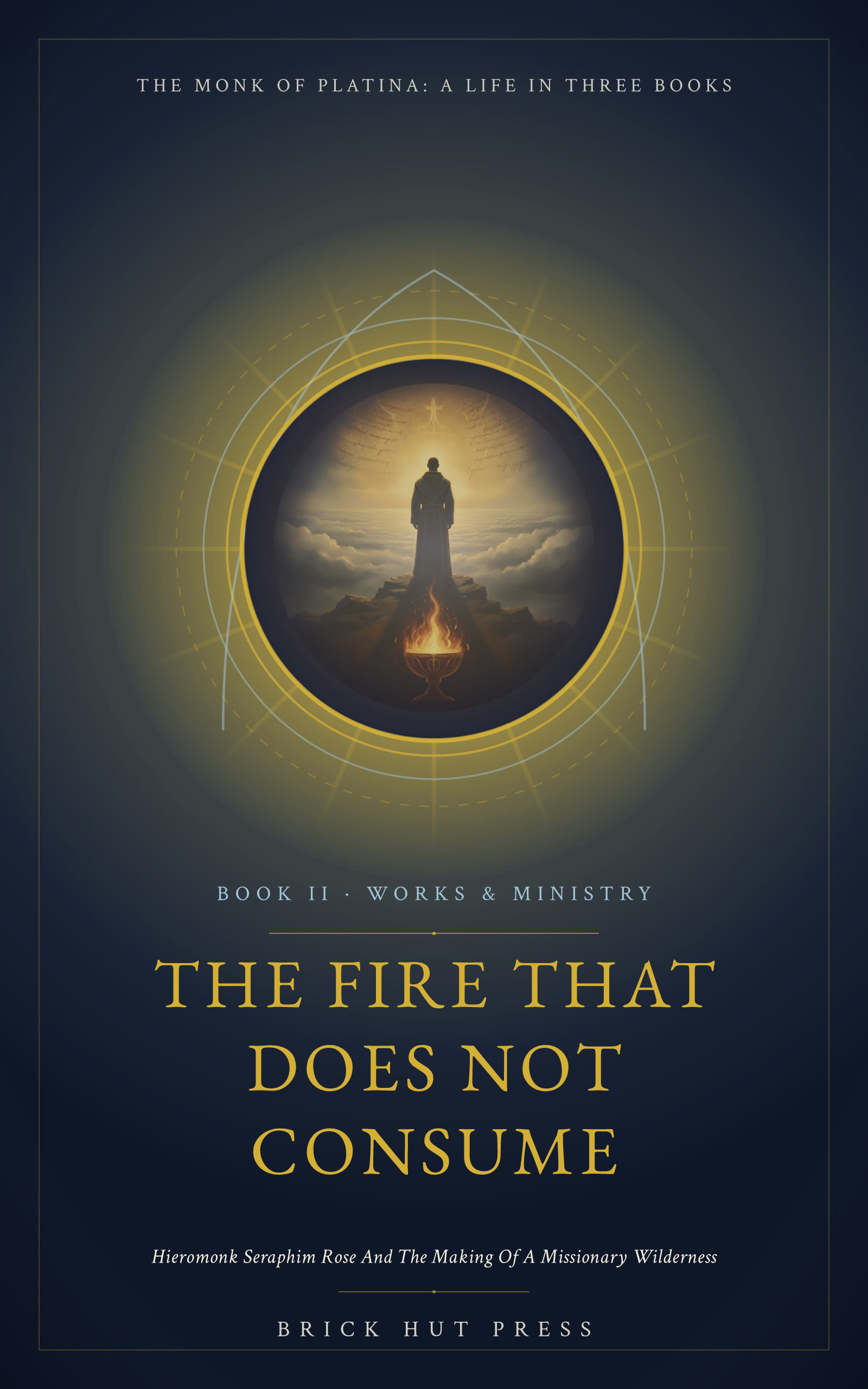
The Fire That Does Not Consume
He Arrived With a Philosopher's Mind. He Left the World Having Lit a Fire That Still Burns. Eugene Rose was not born into the Faith. He was driven to it, through nihilism, through the wreckage of modern philosophy, through the kind of hunger no ideology and no countercultural dream could satisfy. The day he and Fr.
Read the full description
Herman Podmoshensky drove into the mountains of Northern California and did not come back marked the beginning of something the twentieth century had not seen before: a missionary wilderness, built from nothing, that would reach souls across continents. The Fire That Does Not Consume follows the full road, tonsure and the name he had always had, the mimeograph press that carried Orthodox thought far beyond any parish, the books that answered questions the modern world refused to ask, the letters that made him a father to thousands before he held a priestly title, and the repose that closed a life of forty-eight years without closing its influence. The wilderness monastery at Platina, what drove two men there, and what they built Orthodoxy and the Religion of the Future and The Soul After Death, the books that reached where the Church could not yet go The Holy Fathers brought into English, a patristic inheritance opened to a new world The pastoral letters, spiritual fatherhood conducted by hand and post The Iron Curtain could not stop him, how his witness crossed closed borders Santa Cruz, 1981, the last public word before September 2, 1982 Fr. Seraphim Rose died in 1982. He left behind a monastery, a printing press, thousands of letters, and a question that has never stopped echoing: what does it mean to be truly Orthodox in a world that has forgotten God? His answer was not theoretical. It was his life. Book Two of The Monk of Platina: A Life in Three Books.
About this volume
Book Two of The Monk of Platina opens where any reader of Book One will expect it to open: on the road out of San Francisco, in a borrowed flatbed truck loaded with unsold books and a mimeograph machine, carrying two men north toward mountains that, as the volume's first sentence puts it, had no interest in the city at all. This is the volume that answers the question Book One leaves open, not who Eugene Rose became in finding the Church, but what he built once he had found it, and what it cost him to build it in a place with no plumbing, no congregation, and no one watching but God and a small, growing circle of readers scattered across a country that did not yet know what Orthodoxy was.
The chapters trace the founding of the St. Herman of Alaska Brotherhood at Platina with the plainness the subject deserves: two men, a mimeograph machine, and a determination that the words of the Holy Fathers should exist in English before either of them died. Readers will find the tonsure that gave Eugene Rose the name he is said to have always carried, the slow labor of translation that brought patristic voices into a language that had never quite made room for them, and the founding of The Orthodox Word, the journal through which a hermit press in the California wilderness spoke to converts and cradle Orthodox alike. Two chapters take up the books that made Fr. Seraphim's name beyond the monastery gate, Orthodoxy and the Religion of the Future, written as a candle held up against currents he saw gathering in American religious life, and What Happens When We Die, the study that answered, without evasion, one of the questions every soul eventually asks and that most pastors are tempted to leave unanswered.
But this volume is not only a record of publishing and translating. It is also a record of a man becoming, without quite intending to, a father to people he had never met. The chapters on the pastoral letters and on the word "Father", used by his spiritual children before he held any priestly title that required it, trace how a bookish convert with no formal seminary training became a trusted voice for correspondents behind and beyond the Iron Curtain, guiding souls he knew only through the mail, in a wilderness that turned out not to be isolation but a kind of exposed, unshielded nearness to everyone who wrote to him.
Running beneath all of this, and given its own chapter, is the hidden discipline that made the rest possible: the hesychast at the prayer rope, the quiet unrecorded hours of prayer that the public record of books and letters can only gesture toward. The volume does not claim to see behind that curtain, but it insists the curtain was there, and that everything visible in Fr. Seraphim's life at Platina rested on what was not visible.
The book closes where it must: with the last public word delivered at Santa Cruz in the summer of 1981, and with the repose of Fr. Seraphim on September 2, 1982, a death the chapters treat with the same sobriety they bring to everything else, not as an ending arranged for dramatic effect, but as the last page of a life that had, by then, already given away almost everything it had to give.
Readers who come to this volume from Book One will recognize the man; what they will meet here is his work, and the wilderness he made habitable for it. Readers coming to it fresh should know that its subject is not simply a convert's biography but an account of how a mimeograph machine, a mountainside, and an unglamorous fidelity to the Fathers became, in the hands of one hieromonk, a mission whose reach neither he nor his brothers on Geary Boulevard could have predicted the day their truck turned north.
Not sure yet? Begin freely.
The Stranger Who Became a Father, a complete portrait of this life, free, kept in your own library here. The door into all 3 volumes.
Receive the free book →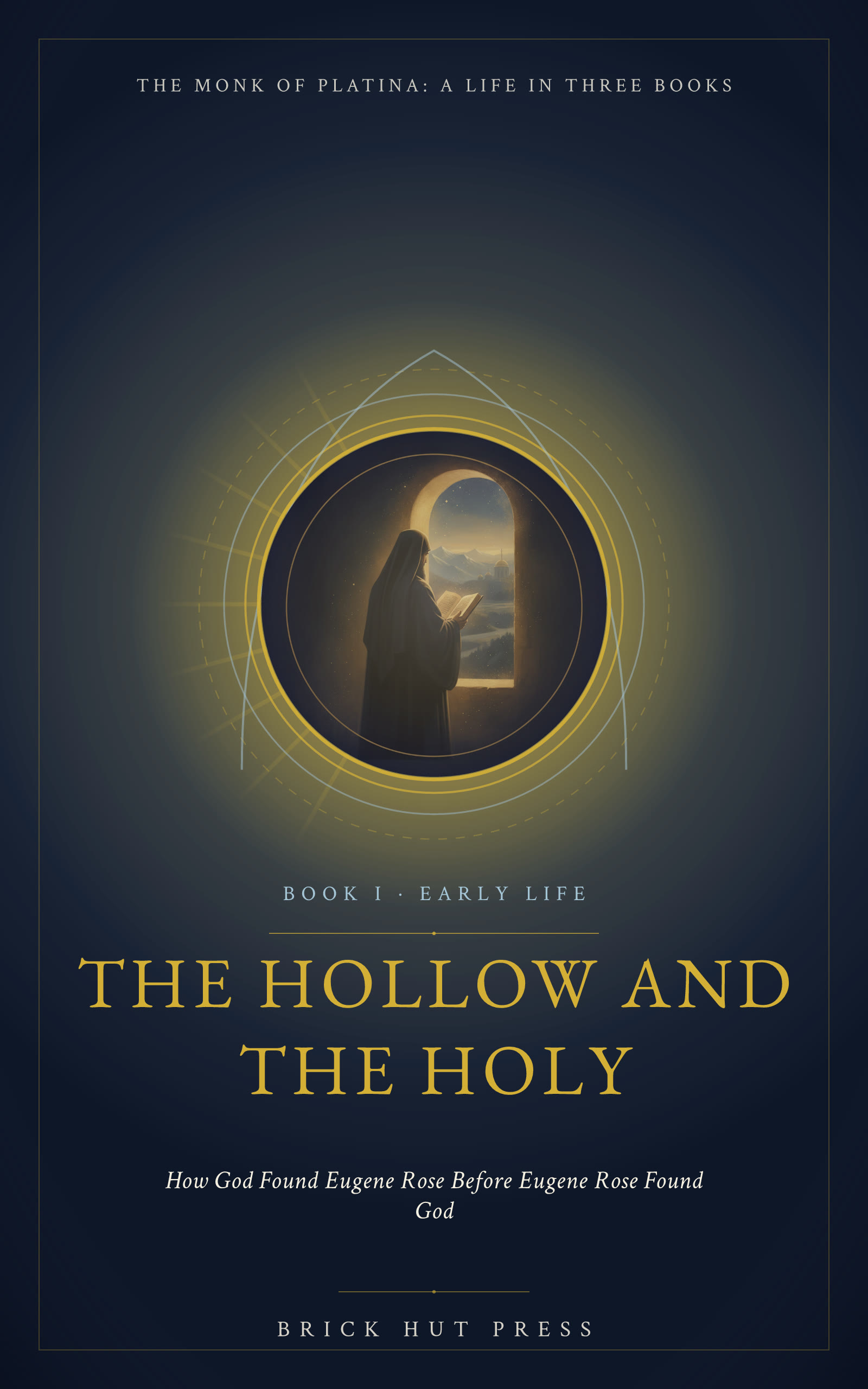
Lives that walk beside Hieromonk Seraphim Rose, chosen for their likeness, not their fame.