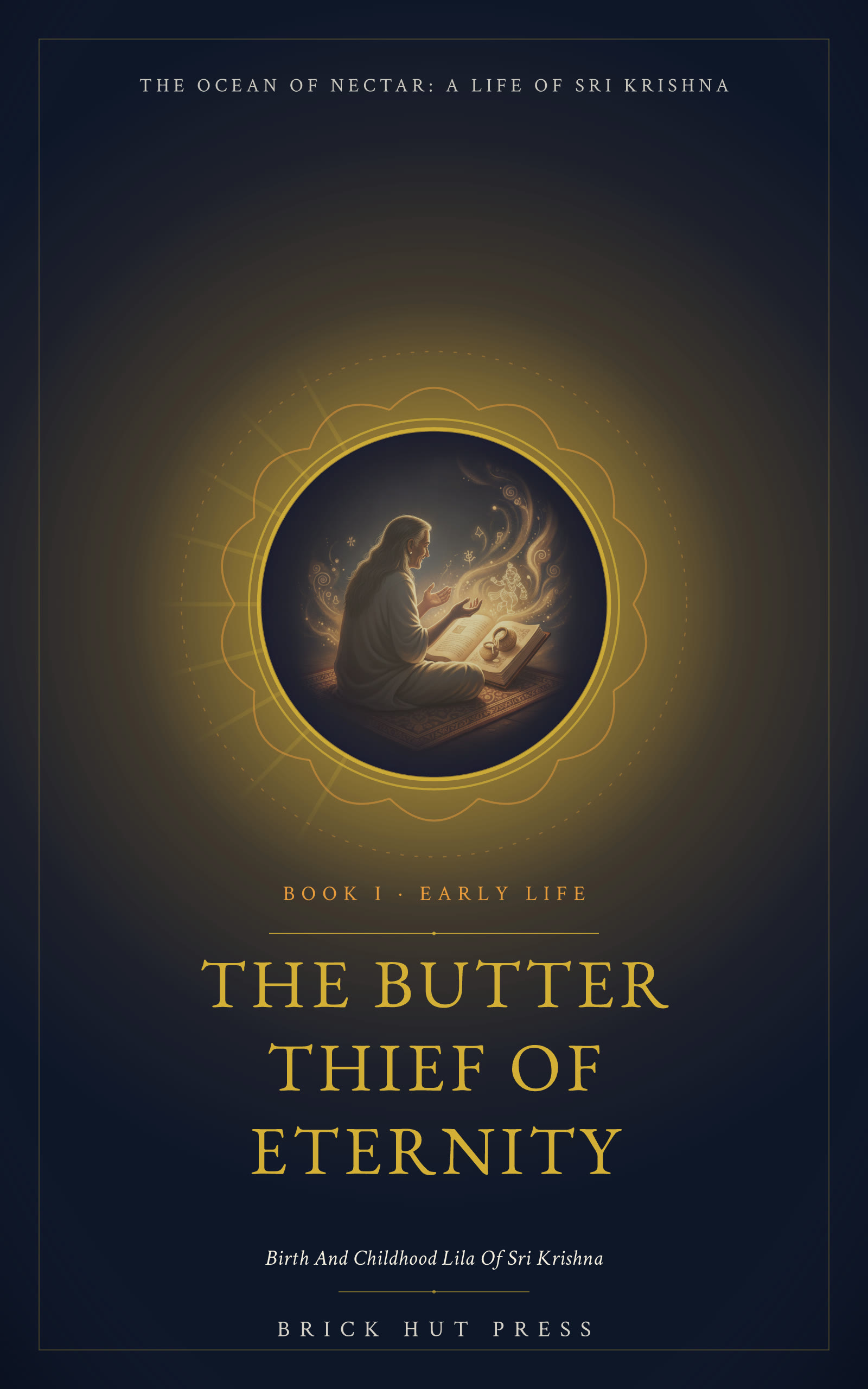
The Butter Thief of Eternity
Before the Gita, before Kurukshetra, before the conch shell sounded across the ages, there was a butter-smeared infant laughing in the dark, a mother whose rope was always too short, and a love so vast it disguised itself as mischief. The Butter Thief of Eternity opens the sacred birth and childhood pastimes of Sri Krishna with the intimacy and wonder these lilas have always deserved.
Read the full description
This is bhakti as an open door, warm, living, and wide enough for every heart that has ever called Krishna its own. Whether you come from a lineage of Vaishnavas, whether you discovered the Bhagavad Gita in a moment of quiet searching, or whether you simply sense something ancient and luminous calling you closer, these pages were written for you. The night of Krishna's divine birth, the Supreme Lord entering the world in chains, in darkness, in a prison cell, and what that choice reveals about the nature of divine love A father's walk into the river, Vasudeva's crossing retold with devotional gravity and wonder She who first called him hers, the mother whose claim on Krishna preceded every other The demons who came for a baby, and what awaited them What Yashoda saw inside his mouth, the breathtaking vision at the heart of Vrindavan's tenderness The rope that could not bind him, and the theology of love hidden inside that impossibility The serpent in the river, the hill held on one finger, Vrindavan's cowherd boy in his full radiant power The flute finds its voice, and the Rasa that followed, and the name Radha, behind every name Readers drawn to the Bhagavad Gita often find themselves hungry for the Krishna who existed before the battlefield, the laughing child, the mischievous thief of butter and of hearts, the blue boy in a green forest.
About this volume
The first volume of The Ocean of Nectar opens not with a flute or a smile but with a prison cell in Mathura, and this is deliberate. Before Vrindavan can bloom, before the butter can be stolen and the gopis called to the riverbank, the reader is asked to sit in the dark with Vasudeva and Devaki, to feel the iron of the chains, the weight of six children lost, the particular stillness of a mother in her ninth month who has already learned what grief can do to hope. This volume knows that the sweetness of Krishna's childhood means little without first understanding the depth of the darkness it was born to answer. Chapter One, "The Night the Universe Held Its Breath," sets that darkness in place so precisely that when the chains fall away in Chapter Two, when a father walks into a flooding river carrying his newborn son above his head, the reader has earned the wonder of it.
From there the volume follows the arc that devotees have carried in their hearts for millennia: the exchange of infants under cover of storm, Yashoda's unknowing claim on a child not born to her, the demonesses and assassins who come one after another for a baby who should be defenseless and never is. The chapter titled "What Yashoda Saw Inside His Mouth" takes up one of the most beloved and unsettling moments in the whole life of Bhagavan, the instant a mother's suspicion of mud-eating dissolves into a vision of the entire cosmos, galaxies and oceans and her own village, held inside her child's open mouth. The book does not rush past this. It lingers, as the Bhagavata Purana itself lingers, on the terror and tenderness of a mother realizing, for one unbearable moment, exactly whom she is raising, and then choosing, as any mother would, to forget it in the very next breath so she can go on loving him as her son.
The middle chapters move outward into the pastures and forests of Vraja: the mischief that could never quite be called sin, the serpent Kaliya driven from the Yamuna, the mountain Govardhana lifted on a single finger to shelter an entire village from the wrath of Indra. These are not treated as isolated wonder-tales strung together for effect. The volume traces how each act deepens the intimacy between Krishna and his Vraja, how a god who could rule the heavens instead spends his boyhood herding cows, stealing butter, and letting himself be scolded by a foster mother who ties him, however briefly, to a mortar with a rope too short for the truth of who he is. "The Rope That Could Not Bind Him" and "Blue Boy in a Green Forest" sit at the heart of this section, holding together the paradox that gives Vaishnava devotion its particular ache: the Lord of all binds himself willingly, out of love, to those who love him without knowing what he is.
The final chapters turn toward the flute, the forest at night, and the name that devotional literature places beside Krishna's own more often than any other. "The Flute Finds Its Voice," "The Night of the Rasa," and "Radha: The Name Behind Every Name" bring the volume to the threshold of the rasa-lila, treated here with the reverence such a mystery demands, not as romance in any ordinary sense, but as the soul's longing rendered visible in moonlight and music. The closing chapter, "What Vrindavan Keeps," steps back from narrative to ask what remains in that forest after the child has grown, what the land itself carries forward for every pilgrim and every reader who comes after.
This is a volume for anyone who wants to meet Krishna first as Vrindavan met him, as a child stealing butter, a boy calming a river, a flute-player whose music could call the cowherd girls out of their homes at midnight, before meeting him later as the charioteer of Kurukshetra. It asks for patience with wonder and tenderness toward mystery, and it offers, in return, the particular joy that only this part of his life contains.
Not sure yet? Begin freely.
One Drop of the Ocean, a complete portrait of this life, free, kept in your own library here. The door into all 3 volumes.
Receive the free book →
Lives that walk beside Sri Krishna, chosen for their likeness, not their fame.