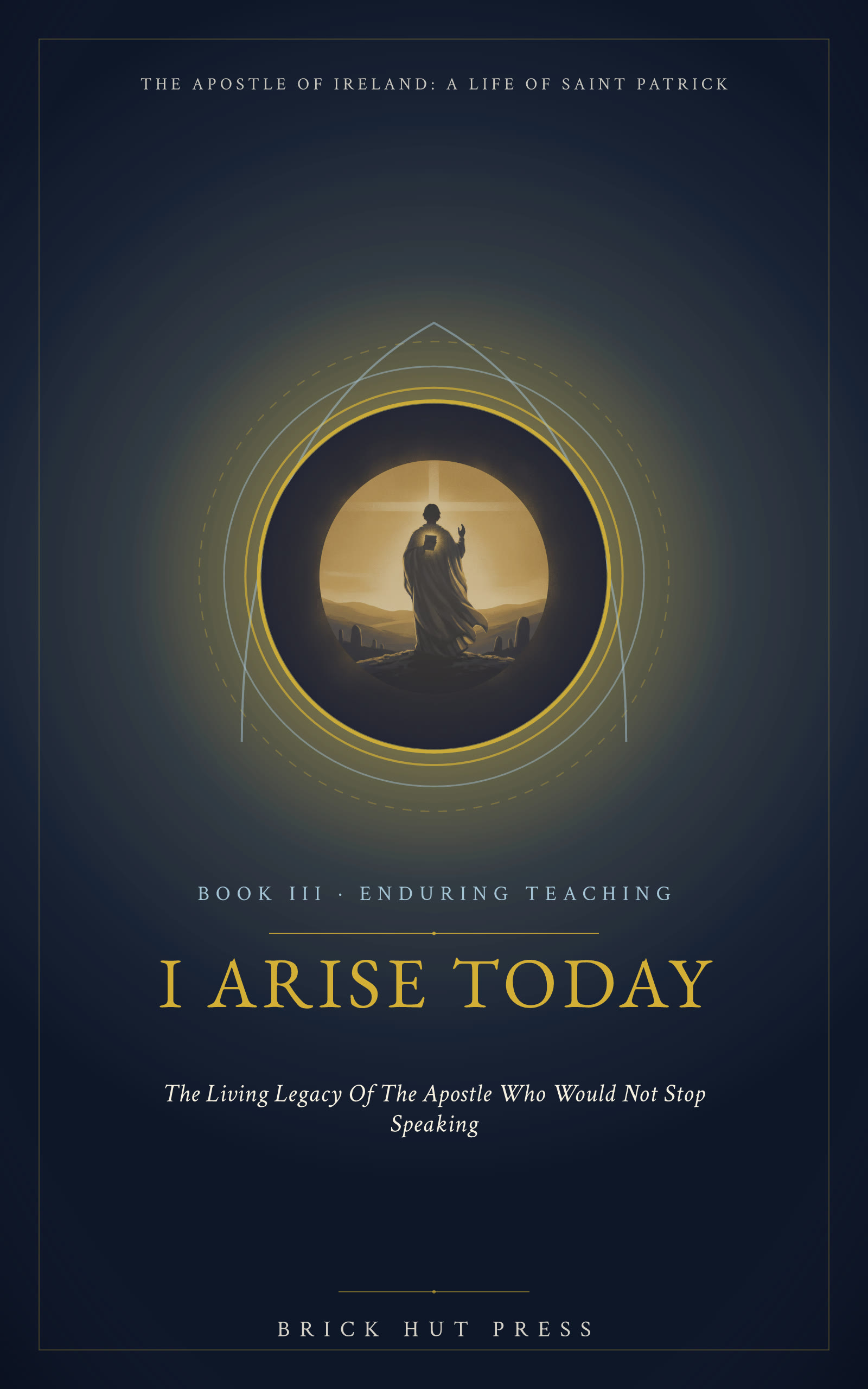
I Arise Today
He Was Taken in Chains. He Returned in Fire. The Real Patrick Still Speaks. Most people know the name. Few know the man. Patrick left behind only two short documents, and with them, helped transform the spiritual imagination of an entire civilization.
Read the full description
I Arise Today strips away the shamrocks and the legend to find something far more astonishing: a fifth-century slave-turned-bishop who wrestled with unworthiness, heard the voice of God in the night, and went back to the people who had enslaved him, not in bitterness, but in blazing, unstoppable love. This is a book about calling, about what happens when grace seizes an ordinary, broken person and refuses to let go. Patrick's own Confessio , his own trembling courage, offer a word that cuts across fifteen centuries without losing a single edge. Patrick in his own voice, what his writings reveal about his theology, his fears, and his unshakeable conviction A theology of grace, how captivity became the furnace in which faith was purified and mission prepared The breastplate prayer as living armour, the spiritual force behind I Arise Today and what Patrick believed he was putting on The island that taught the world, how the church Patrick seeded preserved learning through the darkest centuries Croagh Patrick and Lough Derg, pilgrimage sites that still draw the faithful in their tens of thousands A legacy without borders, Patrick as Patron of Nigeria, protector, and father in faith to communities far beyond Ireland The call for the unqualified, why Patrick's confession speaks directly to the sinner who believes the call is for someone else Patrick is not presented here as a cultural mascot but as a father in faith whose voice, once heard clearly, is impossible to dismiss, as urgently alive now as in the age of the High Kings.
About this volume
This third volume opens where the first two left off, not with the boy taken from the shore, not with the escape and the return, but with an old man, alone, writing by a dying candle. It is a fitting place to begin, because this book is not primarily a life of events. It is a life of what remained: the words Patrick left behind, the prayers attributed to his name, the mountain and the lake where pilgrims still climb and fast, the shamrock in the hand, the church that grew up around the memory of a man who insisted, again and again, that he was unlearned, unworthy, and rustic, and who was believed anyway, and is still believed.
The volume's first chapters stay close to the actual page: the Confession and the Letter to Coroticus, the only writings we can be reasonably sure came from Patrick's own hand. Here the book takes seriously his repeated confession of grace, not grace as a theological abstraction but as the lived experience of a man who was owned as property, who tended sheep in the rain on a foreign hillside, and who came to believe that the God who allowed that captivity was the same God who turned it into a calling. Chapter Two sits with this conviction plainly, without smoothing over its strangeness: that a slave's ruin became, in Patrick's own telling, the very ground of his mission. From there the book turns to the prayer tradition that bears his name, most famously the breastplate that begins "I arise today", not claiming for certain which lines are his and which arose later in devotion around him, but asking what it means that Irish Christians for over a millennium have wanted to arise each morning armored in exactly these words: through the strength of heaven, the light of the sun, the swiftness of the wind.
The middle chapters widen out from the man to the church that remembers him. There is a chapter on what the Irish church never forgot, the shape of monastic discipline, the fierce local loyalty to Patrick's memory even as later centuries layered legend onto fact. There is a chapter on the Book that held him, considering how the manuscript tradition itself, copied and recopied by monks who never met him, became part of his afterlife. And there is real attention paid to the places: Croagh Patrick, where pilgrims still climb barefoot in July: Lough Derg, where the fast and the vigil have gone on for longer than most nations have kept any single custom. These chapters do not treat the mountain and the lake as folklore to be explained away. They treat them as living instruments of a devotion that has outlasted every empire that tried to govern Ireland.
The book does not stay on the island. A chapter considers Patrick's patronage far from Ireland, in Nigeria, where his protection against fear is invoked by communities who never saw green hills or heard Irish spoken, which is its own kind of testimony to what a life fully given over to Christ can become once it leaves the hands of the man who lived it. And throughout, the volume keeps returning to a question with plain pastoral weight: the shamrock as teaching device, the serpents as legend, but beneath both, the harder claim that the call Patrick answered was never reserved for the qualified or the confident. A chapter addressed directly to the sinner who thinks the call is for someone else is not incidental to this book's purpose, it is close to the point of the whole project.
The volume closes as it should, back at the breastplate, the prayer given its full weight after eleven chapters of context: Christ before me, Christ behind me, Christ in the heart of everyone who thinks of me. Readers who have followed Patrick from the shore of his captivity through his mission and now into what became of him afterward will find here not an ending but an inheritance, a man who did not stop speaking, and a church, and a world, still listening.
Not sure yet? Begin freely.
The Fire He Could Not Put Out, a complete portrait of this life, free, kept in your own library here. The door into all 3 volumes.
Receive the free book →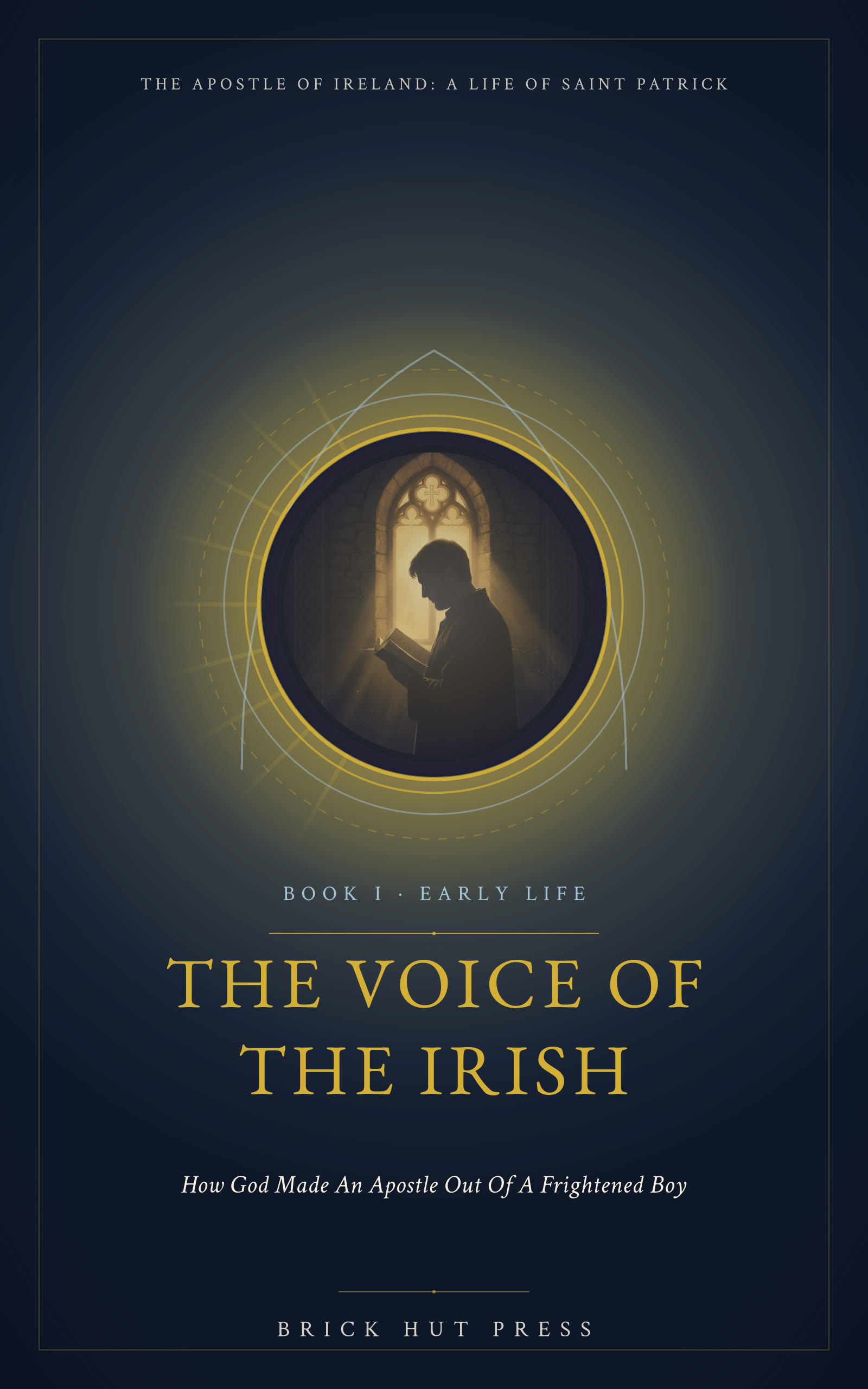
Lives that walk beside Saint Patrick, chosen for their likeness, not their fame.