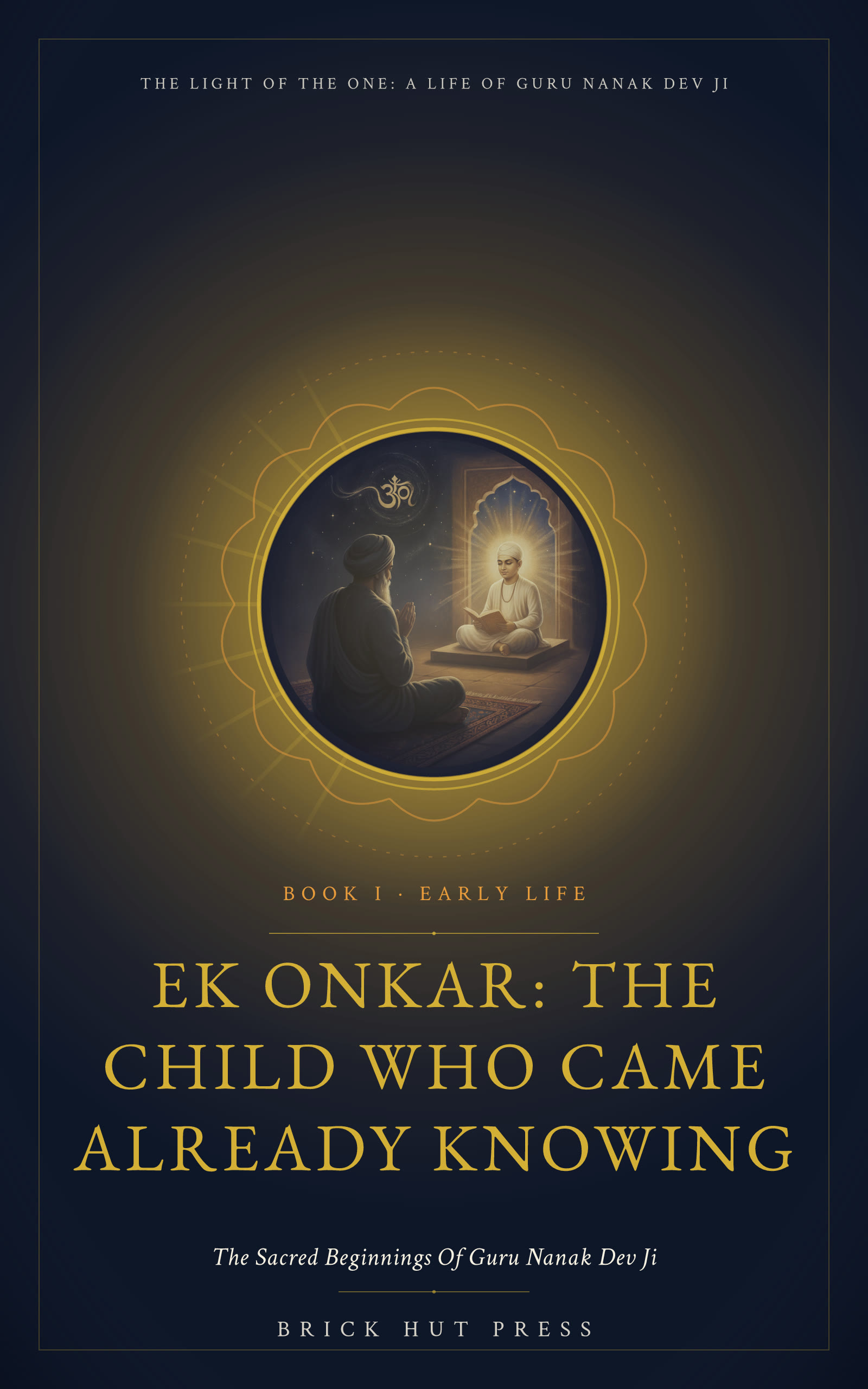
Ek Onkar: The Child Who Came Already Knowing
He Did Not Become Holy. He Arrived Holy. Before the first word of Japji Sahib was ever spoken aloud, before the river Bein fell silent in wonder, before the courts of kings and the hearts of strangers were turned toward the One, there was a child in Talwandi whose very breath carried the fragrance of the Divine. This is not a biography. This is a darshan . And it has been waiting for you.
Read the full description
Ek Onkar: The Child Who Came Already Knowing invites Sikhs and sincere seekers into the sacred childhood of Guru Nanak Dev Ji, not through the cold lens of scholarship, but from inside the warmth of the Gursikh heart. Told in the tradition of a devoted elder who has sat long hours before the Granth Sahib, this book does not ask you to study Guru Nanak Dev Ji. It asks you to sit with him . To feel what Mata Tripta felt when she first looked into the eyes of her newborn son and knew, this child has not come from us. He has come for us all.
About this volume
This is a book for the reader who already touches their forehead to the earth at Nankana Sahib, and for the reader who has never heard that name spoken but wants to understand why it is holy. Ek Onkar: The Child Who Came Already Knowing opens The Light of the One with the first years of Guru Nanak Dev Ji's earthly life, not as the record of a promising boy who would later become enlightened, but as the account of the Light itself learning, gently and deliberately, how to inhabit a small body in a small village in the Punjab. The volume begins under the full moon over Talwandi and carries the reader through childhood and youth into the threshold moment at Sultanpur, ending at the edge of the Bein rivulet, where the world as Talwandi and Sultanpur knew it was about to be given a new and eternal sentence: there is no Hindu, there is no Mussulman.
The chapters move with the patience the subject deserves. We sit with Mata Tripta Ji in the hours of labor and in the quiet gift of her early recognition that this child was not entirely her own. We watch the household and the village register, in small incidents rather than grand pronouncements, that something uncommon was present, the way the buffalo came home themselves, the way a coiled shade seemed to shelter a sleeping infant, the way elders and passersby became, without quite knowing why, the first to see. These are not offered as spectacle. The book asks the reader to notice how ordinary rural life in Talwandi Rai Bhoi di, the accounts kept by Mehta Kalu, the herding of cattle, the rhythms of a Punjabi farming village under Rai Bular's patronage, became the unlikely soil for revelation.
The heart of this volume is education, and its limits. "What the Pandit Could Not Teach" and "The Arabic Letters and the Maulvi's Tears" trace two attempts by two traditions, Hindu and Muslim, to instruct a child who already possessed what they were trying to give him. These chapters are handled with real tenderness toward the teachers themselves, the pandit and the maulvi are not foils but witnesses, men who came near enough to the boy to weep at what they could not hold. This same pattern reaches its most consequential expression in "The Sacred Thread He Would Not Wear," when the child, still young, declines the janeu at his own investiture ceremony, not out of defiance but out of a clarity about what actually binds a soul to the Divine, a clarity the book takes seriously as the first public seed of Gurmat itself.
From there the volume follows Guru Nanak Dev Ji into early adulthood: "The True Bargain," the episode of trade and charity that shows a boy's understanding of wealth already reordered around service; and Sultanpur, where he takes work as an accountant, modaka, the counter of grain and coin, and where the book lingers, in "The Accountant Who Counted Waheguru," on the quiet paradox of a man keeping worldly ledgers while his inner life kept an entirely different accounting. This domestic, working period is not treated as a delay before the real story starts. It is shown as preparation, the years in which the Light continued learning the shape of an ordinary human vocation before that vocation broke open.
The volume closes where every telling of this life must eventually arrive: the disappearance into the Bein before dawn, the three days the village believed him drowned, and the return with words that would reorder how millions of people since have understood who belongs to whom. "Before Dawn on the Bein" and "There Is No Hindu, There Is No Mussulman" are given the space and stillness they require, written neither to explain away the mystery of those three days nor to overstate what can be said about them, but to let the moment stand as the hinge it is, the point where the child who came already knowing begins, at last, to speak as the Guru.
Readers new to Guru Nanak Dev Ji's life will find here a clear, chronological, and reverent foundation; readers who have carried these stories since childhood will find them slowed down, sat with, and honored rather than summarized. This is the first volume of a Life meant to be read the way the tradition itself asks such lives to be read, attentively, unhurried, and with the forehead, in spirit, near the ground.
Not sure yet? Begin freely.
The Light That Waits for You, a complete portrait of this life, free, kept in your own library here. The door into all 3 volumes.
Receive the free book →
Lives that walk beside Guru Nanak Dev Ji, chosen for their likeness, not their fame.